Turkey calling has been an important part of the hunt ever since man discovered he could talk turkey. Before the white man arrived in North America the Native Indians would imitate different turkey sounds to lure toms into an ambush. The native Indians even made calling devises from wood, turtle shells, bones and corncobs. These calls where later taken over by the first European settlers and modified. Many diviations of this first game calls are still used today, such as the wing bone call and the wooden friction calls.
A lot has been written about the different calling techniques. Today, there are many different calls in use from the simple wooden friction box to the mouth call and right up to modern electronic calls operated by remote control and turkey sounds burned onto a CD or microchip. This time of year, with the turkey hunting season only weeks away, you can’t open a hunting magazine that does not devote at least one article to turkey calling.
Most articles will tell you how to call turkeys on private land where birds experience very little hunting pressure. So I decided that I would turn the gobbler around and write about how to call turkeys on public land, or Crown Land for Canadians, afte allr that is where the majority of hunters in North America hunt, including yours truly. Is there a difference between public land and private land turkeys? You bet! Public land turkeys are called to a lot, and mostly badly too. They have heard it all, the good the bad and the ugly. This has made these birds educated and smart they know when you are fake from a mile away. As many public land hunters will tell you these turkeys are some of the toughest birds to hunt. These birds are so paranoid that they often not even will follow a real turkey hen call or just shut up and come sneaking in to your position quietly and hidding behind every tree on the way while inspecting carefully the surounding. Turkeys have an eyesight only equalled by that of an eagle nothing escapes their eyes, not even a tiny ant crawling over a leaf 20 yards away.
So how on earth then can you call such a highly suspicious bird to you? Well, it’s not that difficult, if you stick to basics and keep it simple. When I hunt on public land, and I do that often, then I stick to the simple easy to master calling devices like the wooden friction box call and one or two Slate-and-Peg Calls, one of which usually has a slate top and the other a glass top. The glass call is waterproof when used with a glass or modern composite stricker. I use this call when it rains, which by the way is often the best weather to hunt public land toms because everybody else is staying home and turkreys know that too. The strikers for the slate calls are made of wood, glass and composite materials each gives a slightly different sound from high pitched to low and raspy. Another call I often use for close in calling when I need the turkey to make a couple more steps to me with my gun at the ready, is a push-and-pull friction call. This call I can easily hold and operate with one hand and still aim the gun at the bird at the same time.
Like the calling devices, my calls are simple too. One of the biggest mistakes hunters make on public land is to call too aggressive, to often and use to many different call segments. Remember public land turkeys shut up as soon as the hunting season opens and there is no better way to let a big old tom know that you are not a love sick hen then when you are a "chatterbox" and wont shut up. Don’t talk to much but talk quality. Oh, and by the way don't shout at the tom either he does not like it when he is yelled at by females. Toms are male chauvinists, they like the submissive types, so try to sound not to bossy.
Once I am set up I let the woods around me settle down a bit for about 15 minutes and then I start a short series of soft hen clucks followed by three or four soft yelps after that I wait a few seconds and end my calling with a few soft purrs. After this I put my calls away for about 20 minutes. During the waiting period I am not just sitting under the tree and dream. I look all around me and listen carefully for the faintest sound or movement. Often toms sneak in to calling never making as much as one gobble. Paranoid as they are they take their sweet time, ever so often standing still and looking for the hen. Remember they are paranoid and expect to see a hunter under every tree and bush, so they are very careful. Once I watched a tom approaching me so cautiously that it took him a full hour to cover about 80 yards. Every two steps he stood still and bent his neck in every which direction in an effort to investigate every inch of land for possible danger and at the ready to run. It was quite amazing to watch him hiding behind every tree and using the structure of the land to stay undetected. Often he would disappear for a long time and then emerge again peeking from behind a fallen log or a tree trunk.
When you call try to put some emotion in your calling. Imagine that you are a turkey hen wanting to be desperately visited by a tom. Observe turkeys and listen to them and then try and copy what you observed. A turkey hen does not just stand around and go “yelp-yelp-yelp-cluck-cluck-purr-purr.” Here is how a turkey hen does it. She walks a bit then stands still and clucks, then she scratches the leaves on the ground and clucks again. Now she walks another few steps tilts her head to the side and maybe softly yelps a few times. Then she may walk a bit bored back and forth looking over her shoulder to where she expects the tom to come from and purrs to her hearths content like she wants to say “Here I am honey come to me now, I need you.”
Try to replicate this in your calling sequence by scratching the ground a bit with a twig or your hand. As you call move the call from one side to the other of your body to give the tom the impression that there is a hen walking back and forth. The worst sin hunters can do, next to talking to much to loud and using the wrong calls, is to sound mechanical like robots.
Remember these points when you go to the woods for a shot at a big public land gobbler and you might very well succed in the mission impossible.
1. Use calls that you can master easily. Especially if you are a beginner stay away from mouth calls, they require a lot of practise to sound natural in the time you learn to make one sound with them you can learn all turkey calls in half the time with a box call the slate call and the push-and-pull-call.
2. Use soft yelps, clucks and purrs. Keep the calls nice and friendly not loud and aggressive. Keep the calling sequence short and simple. Don’t call to much and to long. A typical sequence should not be longer than five minutes and then pause for 20 minutes. While you wait look and listen for the slightest movement and sound.
3. Be patient and prepared to sit for an hour or more absolutly still. Don't give up just because you heard a gobbler and then he shut. This does not necerssary mean he wont come in to you, he might be on his way tight lipped and eagle eyed. The longest time I have ever sat at the same spot to wait for a tom, which I knew was on his way in, was over an hour. By the time he finally came to within shooting range my rear end was so numb you could have poked a nail into it and I wouldn't have felt a thing, but that is another story for another time.
In my next article we will look at the different weapons for turkey hunting and which one of these in my opinion is the best gobbler medicine.

Monday, February 27, 2006


Tuesday, February 21, 2006
Hunting: You Asked for It
My turkey hunting articles seemed to be very popular with the readers. I have been asked from several visitors to provide more in depth information on the subject. Your wish is my command.
Over the next several days I will publish several articles here dealing with different aspects of turkey hunting, such as what weapon is best suited to hunt this birds. How to call turkeys and what calls to use and then finally some tactics that will get you close to gobblers.
So stay tuned here to get the full scoop of information on turkey hunting.
Over the next several days I will publish several articles here dealing with different aspects of turkey hunting, such as what weapon is best suited to hunt this birds. How to call turkeys and what calls to use and then finally some tactics that will get you close to gobblers.
So stay tuned here to get the full scoop of information on turkey hunting.
Sunday, February 19, 2006
Close Encounters
© By Othmar Vohringer
 On a glorious May morning my hunting partner and I went turkey hunting in a northern Illinois state park. This was my partner’s first turkey hunt and I wanted it to be a memorable experience for him. Little did we know that this would become the most memorable day in our lives. The predawn found us in a prime spot that I had scouted out the previous week just for this occasion. I chose an ambush site on the edge of a woodlot and just below a ridge top. After flying down from the roost the turkeys would walk along the ridge top that gently sloped down to an open field.
The set up was perfect. Any tom that would come in to investigate my calling would have to walk within shooting distance before he could see where the calls came from. On public land this is my favourite set up. Lets face it. Public land turkeys are smart and hunter-wise; they know instantly that something is wrong when they can hear a hen call but from a distance can’t see another turkey where they expect it to be. Setting up in such a way that a gobbler has to walk within shooting distance to be able to see will greatly improve your odds of shooting a tom on public land.
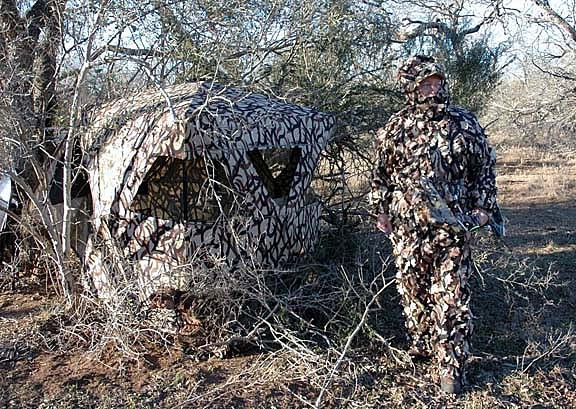 I was sitting comfortably and well camouflaged in my ASAT 3-D suit at the bottom of an old oak located about 30 yards inside the woodlot. My hunting partner was located about 40 yards to my left and forward from my location at the edge of the woodlot at the bottom of an old pine tree that gave him good cover. As soon as my partner gave me the signal that he was ready I began to produce soft yelps and purrs with a few gentle clucks mixed in for good measure on a slate call.
It didn’t take long until my calling was answered with thunderous gobbles. Judging by the sound it had to be at least three toms answering my imitation of a lovesick hen. I could tell from the sound that one of the birds had come closer to our set up and signalled to my partner to get his gun ready. If the longbeard kept coming from that direction he would walk right past my partner. Should he change direction and come to the right of my partner I would get a shot at him. Either way that tom was as a good as ours provided he kept coming. More soft hen talk produced no more answers from the gobbler, which is not uncommon for public land turkeys and meant that he could be very close or that he had lost interest. I kept looking intently to my right side, carefully scanning the area for every little movement with my shotgun at the ready to send a swarm of angry # 4 pellets the gobbler’s way the moment he should pop his head up from anywhere inside 40 yards. My partner did the same; covering his shooting lanes to the left side. I could feel the tension and excitement oozing from both of us.
I must have been preoccupied like that for, oh I don't know, maybe 15 or 20 minutes when I felt something tugging on my ASAT 3-D camouflage pants. Should I turn around and see what it was or keep looking out for that big old tom that might at any second walk right in front of my Winchester's 12 gauge barrel? Eventually the tugging got more persistent to the point where I had the distinct feeling something was nibbling on my leg. Finally I had enough of that interruption of my concentration. Slowly I began to turn my head in minute increments because turkeys have exceptional eyesight and can spot you blinking an eye from 100 yards away, so slow motion movement in an absolute must.
I turned my head just enough to see from the corner of my eyes what the cause of the distraction was. “What the heck!” I shouted as I jumped up. My heart was racing at such speeds that I feared I might become the victim of a heart attack while at the same time trying to stop my bladder from emptying itself into my pants. I was literally face to face with a big whitetail buck trying to eat my leafy camo pants. My hunting partner turned around to see what the commotion was all about and became my crown witness for something that nobody would believe if I told them without his back up. Seconds after my initial shout of surprise the buck snorted, did an about-face, and crashed through the woods like a runaway train almost knocking my hunting partner over. He probably was more scared than I was. The buck was no stranger to me, only a button buck at this time of year, I recognized his gnarly old face and slight limb as the big 8 point with heavy mass antlers that I hunted hard in the past season.
What really puzzled me about this encounter was how close this buck came to me. I mean he nibbled on my camo pants! And since I was turkey hunting I never bothered to make sure I was wearing freshly laundered clothing or go to any length whatsoever to control human scent. When turkey hunting there is no need for such measures since turkeys can’t smell.
That he could be fooled by my ASAT camouflage, which blends in so well that a hunter becomes part of the surrounding vegetation even at very close range, did not surprise me. In the past I had animals and hunters completely overlook me dressed in ASAT camo. But that the deer chose to investigate something he could smell even though he could not see it (me) is still miraculous to me and so was that once in a lifetime experience where I was actually so close to a deer that I could have grabbed it by the antlers and felt his breath in my face.
About 15 years ago I conducted my own extensive camouflage effectiveness test. This was a test in which I tested four different camouflage patterns under the conditions deer and other game see it. When the test results came back ASAT was the clear winner leaving all other camouflage patterns literally in the dark. ASAT’s unique pattern mimics the light and shadows that are everywhere in nature; be that in a forest, dessert, mountains or in the marsh. ASAT works equally well in all seasons as it does in all terrains. It is this light shadow mimicry that does the best job of breaking the human outline completely up and lets a hunter vanish in plain sight of game and other hunters. Because of the results of this test my camouflage of choice is ASAT. Oh sure, I have seen deer and turkeys before while wearing other camouflage, but with ASAT I see more game because animals can’t see me. Ever wondered why that deer or turkey hangs up and keeps staring in your direction? Wear ASAT and that won’t happen again.
Incidentally, the following fall I scouted this buck’s hideout and knew that when the hunters came onto the land he would seek refuge on a neighbouring farm which was off-limits for hunters. But as it happened I knew the farmer very well and when I told him about the buck and that he blew my chances on a big old tom in the spring he gave me permission to hunt on his property. In the late winter season on a bitter cold January morning it all came together and I ran an arrow through that buck as he stepped right under my treestand.
To learn more about my choice of camouflage visit the ASAT website.
To learn more about Wild Turkeys and turkey hunting visit my blog Wild Turkey Fever.
To keep up to date about deer hunting visit my blog Whitetail Deer Passion
(Top image courtesy of Artemis Graphics and Design. Camouflage image used in this article courtesy of ASAT Outdoors, LLC.)
Tags: ASAT Camouflage, Close Encounters, Turkey Hunting, Whitetail Deer Buck
 On a glorious May morning my hunting partner and I went turkey hunting in a northern Illinois state park. This was my partner’s first turkey hunt and I wanted it to be a memorable experience for him. Little did we know that this would become the most memorable day in our lives. The predawn found us in a prime spot that I had scouted out the previous week just for this occasion. I chose an ambush site on the edge of a woodlot and just below a ridge top. After flying down from the roost the turkeys would walk along the ridge top that gently sloped down to an open field.
The set up was perfect. Any tom that would come in to investigate my calling would have to walk within shooting distance before he could see where the calls came from. On public land this is my favourite set up. Lets face it. Public land turkeys are smart and hunter-wise; they know instantly that something is wrong when they can hear a hen call but from a distance can’t see another turkey where they expect it to be. Setting up in such a way that a gobbler has to walk within shooting distance to be able to see will greatly improve your odds of shooting a tom on public land.
I was sitting comfortably and well camouflaged in my ASAT 3-D suit at the bottom of an old oak located about 30 yards inside the woodlot. My hunting partner was located about 40 yards to my left and forward from my location at the edge of the woodlot at the bottom of an old pine tree that gave him good cover. As soon as my partner gave me the signal that he was ready I began to produce soft yelps and purrs with a few gentle clucks mixed in for good measure on a slate call.It didn’t take long until my calling was answered with thunderous gobbles. Judging by the sound it had to be at least three toms answering my imitation of a lovesick hen. I could tell from the sound that one of the birds had come closer to our set up and signalled to my partner to get his gun ready. If the longbeard kept coming from that direction he would walk right past my partner. Should he change direction and come to the right of my partner I would get a shot at him. Either way that tom was as a good as ours provided he kept coming. More soft hen talk produced no more answers from the gobbler, which is not uncommon for public land turkeys and meant that he could be very close or that he had lost interest. I kept looking intently to my right side, carefully scanning the area for every little movement with my shotgun at the ready to send a swarm of angry # 4 pellets the gobbler’s way the moment he should pop his head up from anywhere inside 40 yards. My partner did the same; covering his shooting lanes to the left side. I could feel the tension and excitement oozing from both of us.
I must have been preoccupied like that for, oh I don't know, maybe 15 or 20 minutes when I felt something tugging on my ASAT 3-D camouflage pants. Should I turn around and see what it was or keep looking out for that big old tom that might at any second walk right in front of my Winchester's 12 gauge barrel? Eventually the tugging got more persistent to the point where I had the distinct feeling something was nibbling on my leg. Finally I had enough of that interruption of my concentration. Slowly I began to turn my head in minute increments because turkeys have exceptional eyesight and can spot you blinking an eye from 100 yards away, so slow motion movement in an absolute must.
I turned my head just enough to see from the corner of my eyes what the cause of the distraction was. “What the heck!” I shouted as I jumped up. My heart was racing at such speeds that I feared I might become the victim of a heart attack while at the same time trying to stop my bladder from emptying itself into my pants. I was literally face to face with a big whitetail buck trying to eat my leafy camo pants. My hunting partner turned around to see what the commotion was all about and became my crown witness for something that nobody would believe if I told them without his back up. Seconds after my initial shout of surprise the buck snorted, did an about-face, and crashed through the woods like a runaway train almost knocking my hunting partner over. He probably was more scared than I was. The buck was no stranger to me, only a button buck at this time of year, I recognized his gnarly old face and slight limb as the big 8 point with heavy mass antlers that I hunted hard in the past season.
What really puzzled me about this encounter was how close this buck came to me. I mean he nibbled on my camo pants! And since I was turkey hunting I never bothered to make sure I was wearing freshly laundered clothing or go to any length whatsoever to control human scent. When turkey hunting there is no need for such measures since turkeys can’t smell.
That he could be fooled by my ASAT camouflage, which blends in so well that a hunter becomes part of the surrounding vegetation even at very close range, did not surprise me. In the past I had animals and hunters completely overlook me dressed in ASAT camo. But that the deer chose to investigate something he could smell even though he could not see it (me) is still miraculous to me and so was that once in a lifetime experience where I was actually so close to a deer that I could have grabbed it by the antlers and felt his breath in my face.
About 15 years ago I conducted my own extensive camouflage effectiveness test. This was a test in which I tested four different camouflage patterns under the conditions deer and other game see it. When the test results came back ASAT was the clear winner leaving all other camouflage patterns literally in the dark. ASAT’s unique pattern mimics the light and shadows that are everywhere in nature; be that in a forest, dessert, mountains or in the marsh. ASAT works equally well in all seasons as it does in all terrains. It is this light shadow mimicry that does the best job of breaking the human outline completely up and lets a hunter vanish in plain sight of game and other hunters. Because of the results of this test my camouflage of choice is ASAT. Oh sure, I have seen deer and turkeys before while wearing other camouflage, but with ASAT I see more game because animals can’t see me. Ever wondered why that deer or turkey hangs up and keeps staring in your direction? Wear ASAT and that won’t happen again.
Incidentally, the following fall I scouted this buck’s hideout and knew that when the hunters came onto the land he would seek refuge on a neighbouring farm which was off-limits for hunters. But as it happened I knew the farmer very well and when I told him about the buck and that he blew my chances on a big old tom in the spring he gave me permission to hunt on his property. In the late winter season on a bitter cold January morning it all came together and I ran an arrow through that buck as he stepped right under my treestand.
To learn more about my choice of camouflage visit the ASAT website.
To learn more about Wild Turkeys and turkey hunting visit my blog Wild Turkey Fever.
To keep up to date about deer hunting visit my blog Whitetail Deer Passion
(Top image courtesy of Artemis Graphics and Design. Camouflage image used in this article courtesy of ASAT Outdoors, LLC.)
Tags: ASAT Camouflage, Close Encounters, Turkey Hunting, Whitetail Deer Buck
Saturday, February 18, 2006
Politics: Good News for Firearm Owners in Arizona
I found the article below on the website and forum of Water and Woods of which I am a member. I thought that this is such good news that I just had to post it here as is.
Speaking of Water and Woods, if you look for a good source of hunting and fishing information then you should visit this website and join their huge forum. This is very likely the largest website and forum on the internet where you can get all information you ever wanted or needed without the annoying pop ups and the buy this buy that gimmicks. To but it simply, it's a website and forum made for hunters by hunters.
Bill To Protect Gun Owners In Emergencies
State lawmakers want to make sure that state officials do not take your guns the next time a hurricane strikes Arizona.
Or an earthquake, flood, invasion or pandemic.
The Senate Government Committee approved legislation Thursday that would specifically make it illegal for the governor or any official to confiscate legally kept firearms during a state of emergency. The 5-2 vote sends the measure to the full Senate.
Sen. Dean Martin, R-Phoenix, said this isn't some academic exercise.
He said that in the aftermath of hurricane Katrina, New Orleans police began taking guns from residents. Martin said that included not only criminals but other people who were simply defending themselves or their homes.
"In one case it was a little old lady sitting in her own house," he said.
The action in Louisiana eventually resulted in a federal judge issuing a restraining order blocking further seizures and ordering police to return confiscated firearms. Martin said it should not have to come to that here.
Existing state law gives the governor broad powers during a declared emergency. That includes "all police power vested in the state by the constitution and laws of this state."
Gary Christensen, a member of the Arizona State Rifle and Pistol Association, said the experience of Katrina proves that some statutory limits are necessary here.
"If ever there was a time to support the Second Amendment it's during a state of emergency," he said. "People are left on their own in the initial stages of natural disaster and riots."
Sen. Bill Brotherton, D-Phoenix, said the measure, SB 1425, is built on the incorrect presumption that constitutional rights can never be suspended in emergencies. He said, for example, that a curfew can interfere with the First Amendment right of people to assemble.
And Brotherton said there may be legitimate reasons to control the number of guns on the street during an emergency.
Sen. Albert Hale, D-Window Rock, was more blunt, calling the legislation "a license to shoot first and ask questions later."
Martin said nothing in his legislation prohibits police from exercising control through things like a curfew. He said people who go on the streets during prohibited hours with their weapons would still be subject to arrest.
He acknowledged that nothing in his legislation would bar similar action by the president in the case of a nationally declared emergency, as state lawmakers have no sway over federal law.
Speaking of Water and Woods, if you look for a good source of hunting and fishing information then you should visit this website and join their huge forum. This is very likely the largest website and forum on the internet where you can get all information you ever wanted or needed without the annoying pop ups and the buy this buy that gimmicks. To but it simply, it's a website and forum made for hunters by hunters.
Bill To Protect Gun Owners In Emergencies
State lawmakers want to make sure that state officials do not take your guns the next time a hurricane strikes Arizona.
Or an earthquake, flood, invasion or pandemic.
The Senate Government Committee approved legislation Thursday that would specifically make it illegal for the governor or any official to confiscate legally kept firearms during a state of emergency. The 5-2 vote sends the measure to the full Senate.
Sen. Dean Martin, R-Phoenix, said this isn't some academic exercise.
He said that in the aftermath of hurricane Katrina, New Orleans police began taking guns from residents. Martin said that included not only criminals but other people who were simply defending themselves or their homes.
"In one case it was a little old lady sitting in her own house," he said.
The action in Louisiana eventually resulted in a federal judge issuing a restraining order blocking further seizures and ordering police to return confiscated firearms. Martin said it should not have to come to that here.
Existing state law gives the governor broad powers during a declared emergency. That includes "all police power vested in the state by the constitution and laws of this state."
Gary Christensen, a member of the Arizona State Rifle and Pistol Association, said the experience of Katrina proves that some statutory limits are necessary here.
"If ever there was a time to support the Second Amendment it's during a state of emergency," he said. "People are left on their own in the initial stages of natural disaster and riots."
Sen. Bill Brotherton, D-Phoenix, said the measure, SB 1425, is built on the incorrect presumption that constitutional rights can never be suspended in emergencies. He said, for example, that a curfew can interfere with the First Amendment right of people to assemble.
And Brotherton said there may be legitimate reasons to control the number of guns on the street during an emergency.
Sen. Albert Hale, D-Window Rock, was more blunt, calling the legislation "a license to shoot first and ask questions later."
Martin said nothing in his legislation prohibits police from exercising control through things like a curfew. He said people who go on the streets during prohibited hours with their weapons would still be subject to arrest.
He acknowledged that nothing in his legislation would bar similar action by the president in the case of a nationally declared emergency, as state lawmakers have no sway over federal law.
Misc.: Busy Times
Tomorrow I am off on a two day fishing trip. I am going to Buntzen lake and see or I can coax a few trout, my favourite game fish, into taking my bait. After a cold and windy two days which kept the fish from feeding they should be very hungry by now and therefore the fishing good. Regardless how this trip turns out you will read all about it right here.
After this trip it will be time to get ready for British Columbia's biggest Outdoor and Hunting Show. For three days I will have time to look around and check out what's new and where the trends are heading. When I come back I will have plenty to report to you.
Somewhere in between all this I still will post the promised article about the best ambush tactics to bag a big gobbler. So stay tuned here and come back often. There is plenty coming your way in form of news, tactics and tips.
After this trip it will be time to get ready for British Columbia's biggest Outdoor and Hunting Show. For three days I will have time to look around and check out what's new and where the trends are heading. When I come back I will have plenty to report to you.
Somewhere in between all this I still will post the promised article about the best ambush tactics to bag a big gobbler. So stay tuned here and come back often. There is plenty coming your way in form of news, tactics and tips.
Wednesday, February 15, 2006
Mis.: My Valentines Present
I am very fortunate, not only does my wife let me go to the woods to hunt all sorts of critters and to the rivers and lakes to fish but she also surprises me on special occasions with thoughtful and very useful manly toys. This Valentines Day was no different. I had a new fishing rod on my wish list for quit some time now. Lo and behold this Valentine Day a beautiful new fishing rod with reel was presented to me.It’s a Shimano 5.6ft fast action rod for a line weight of 2-6lb with an Okuma Acuador FS30 reel. It’s the perfect light outfit needed for trout fishing.
Now you understand why I love my wife so very much for so many years. She has never nagged at me for being away from home so often to play in the woods and on the lakes and streams with my hunting and fishing toys. She actually supports me and feels, as I do, that a man should be a man and do manly stuff rather than moping around all weekend long. Ah, isn't real love a bautiful thing, I am such a lucky guy.
This upcoming weekend I will take the new rod to one of the many good trout lakes and rivers around my home and put it trough it’s paces. You will be the first one, after me, to know how it went and how the new gear performed you will read all about it on this blog.
Now you understand why I love my wife so very much for so many years. She has never nagged at me for being away from home so often to play in the woods and on the lakes and streams with my hunting and fishing toys. She actually supports me and feels, as I do, that a man should be a man and do manly stuff rather than moping around all weekend long. Ah, isn't real love a bautiful thing, I am such a lucky guy.
This upcoming weekend I will take the new rod to one of the many good trout lakes and rivers around my home and put it trough it’s paces. You will be the first one, after me, to know how it went and how the new gear performed you will read all about it on this blog.
Tuesday, February 14, 2006
News: Dick Cheney and Firearm Safety
I am sure by now everybody has heard about the American Vice President blasting a shotgun load of pellets into his friends face during a recent hunting trip. It is reported that the accidents victim Harry Whittington, a millionaire attorney from Austin is in stable condition. It took the Vice Presidents office more than 24 hours to confirm the accident and only after the news appeared on the Website of the local Corpus Christi Caller Times.
It is further reported that Dick Cheney did not see Whittington coming up from behind him to retrieve a bird he shot. When he got up Cheney blasted him in the face with the shotgun. Both hunters wore blaze orange hunting vests. How can you not see a fellow hunter who only stands 30 yards away from you wearing a bright orange vest?
But what concerns me more about this accident is that the news has given the wrong impression to the non-hunting, non-firearm owning population. They are let in the belief that if you are a hunter and shoot at somebody nothing is going to happen to you. That all that is needed is a half hearted apology and only then if you are embarrassed into it.
The fact however is, that if such an accident happen to the Joe Average hunter, he will be arrested have his firearm confiscated and his hunting and firearm owner licence taken away from him. He then will face an investigation followed by a court trial and very likely is to be sued out of existence by the accident victim. If the hunter causing the accident is found guilty of neglecting the hunter and firearm safety standards he can be prohibited from going to hunt and owning a firearm from anything of one year up to five years and in drastic cases even for lifetime.
I doubt very much that anything like that will happen to Dick Cheney, he probably will be going hunting tomorrow as far as we know. The lunatic anti everything fringe of society will leap at this opportunity to spew forth their diatribe and political rethoric about gun safety and how important firearm control is. Dick Cheney is indeed a "Dick" but lucky such accident are very rare in the hunting community. With millions of hunters in the field totting firearms, hunting is still one of the safest recreational sports, safer than tennis and basketball. According to the US accident statistics more people die accidentally roller blading than by hunting. The fatal accident rate by hunters is less than 0.02% anually and there are about five million hunters in America. That is less than 3 people diying accidentally trough firearm accidents. This makes hunting one of the safest sports there is.
But back to Dick Cheney and the hunting accident.
Dick Cheney carelessly has violated some of the most common basic hunter safety standards with which every hunter is familiar. These are.
1. Treat any firearm as if they where loaded.
2. Never pull the trigger unless you have fully identified your target as such.
3. Always point the muzzle in a safe direction, away from you and other people.
4. Be sure of your target and its surrounding and beyond it. (Never shoot at a target that is sky lighted or only partially visible or that you not otherwise have clearly identified as such.)
5. Make sure the ammunition is the right size for your firearm.
6. Make sure the barrel is free of obstructions before you load a firearm.
7. Never take any chances with a loaded firearm.
8. Don’t relay on the safety feature on your firearm.
9. Store firearms and ammunition in safe place where only you or by you authorized people have access.
10. Never load a firearm before you are ready to shoot or hunt.
11. Never ever mix alcohol, drugs and firearms and/or ammunition.
12. Never think that you are safe know you are safe by observing the guidlines and all firearms regulations. Make sure other hunters in your party know the safe firearm handling procedures.
In addition to this safety standards and specially for the upcoming spring turkey hunting seasonand if you hunt on public land where you are very likely to encounter other turkey hunters -let’s hope you don’t run into Dick Cheney - you might follow these additional safety standards.
1. Always wear a blaze orange vest on your way to your turkey set up and again after the hunt when you go back to your truck or to another location.
2. Do not use turkey decoys, they could be mistaken for the real thing and be shot at by other hunters.
3. Tie a blaze orange ribbon, about five feet of the ground, around the tree you have chosen as your stand location. This ribbons will warn other hunters that hunting is in progress at this location. Blaze orange ribbons do not spook turkeys as some hunters would have you belief.
4. Never raise your gun and aim at sound, it could be another hunter making turkey calls or coming your way. Only aim and shot when you're absolutly sure what you see is a legal to kill turkey.
5. You should not stalk (bushwhack) turkeys on public land, you could be mistaken for a turkey and be shot at.
6. If you see another hunter approaching you stand location sit still and make yourself known by shouting loud at the other hunter. Do not wave or use a turkey call.
7. If you on your way to your location see a turkey make sure it is not a decoy before you raise your gun up and aim. If you see another hunter sitting at the bottom of a tree do not wave at him. Stay still and shout at him or make a slow retrat keeping an eye on the hunter.
8. If you have been successful in shooting a turkey wrap it into a bright red or blaze orange cover before you carry it out of the woods.
9. Use commonsense and keep your eyes open for possible danger at all times.
10. Before you aim at a turkey be sure of your target and beyond.
11. If in doubt about safety let the opportunity to shot a bird pass by. You will get another chance another time and it’s a lot easier to live with that being a lifetime sorry.
I guess what I want to say with all that is don’t be a Dick Cheney, or Richard Cranium, as we call him around here. Be safe be resposible and conciderate of others and then you will have fun.
Stay tuned for my upcoming turkey hunting strategies which will help you bagging that big ol’tom you have been dreaming about.
It is further reported that Dick Cheney did not see Whittington coming up from behind him to retrieve a bird he shot. When he got up Cheney blasted him in the face with the shotgun. Both hunters wore blaze orange hunting vests. How can you not see a fellow hunter who only stands 30 yards away from you wearing a bright orange vest?
But what concerns me more about this accident is that the news has given the wrong impression to the non-hunting, non-firearm owning population. They are let in the belief that if you are a hunter and shoot at somebody nothing is going to happen to you. That all that is needed is a half hearted apology and only then if you are embarrassed into it.
The fact however is, that if such an accident happen to the Joe Average hunter, he will be arrested have his firearm confiscated and his hunting and firearm owner licence taken away from him. He then will face an investigation followed by a court trial and very likely is to be sued out of existence by the accident victim. If the hunter causing the accident is found guilty of neglecting the hunter and firearm safety standards he can be prohibited from going to hunt and owning a firearm from anything of one year up to five years and in drastic cases even for lifetime.
I doubt very much that anything like that will happen to Dick Cheney, he probably will be going hunting tomorrow as far as we know. The lunatic anti everything fringe of society will leap at this opportunity to spew forth their diatribe and political rethoric about gun safety and how important firearm control is. Dick Cheney is indeed a "Dick" but lucky such accident are very rare in the hunting community. With millions of hunters in the field totting firearms, hunting is still one of the safest recreational sports, safer than tennis and basketball. According to the US accident statistics more people die accidentally roller blading than by hunting. The fatal accident rate by hunters is less than 0.02% anually and there are about five million hunters in America. That is less than 3 people diying accidentally trough firearm accidents. This makes hunting one of the safest sports there is.
But back to Dick Cheney and the hunting accident.
Dick Cheney carelessly has violated some of the most common basic hunter safety standards with which every hunter is familiar. These are.
1. Treat any firearm as if they where loaded.
2. Never pull the trigger unless you have fully identified your target as such.
3. Always point the muzzle in a safe direction, away from you and other people.
4. Be sure of your target and its surrounding and beyond it. (Never shoot at a target that is sky lighted or only partially visible or that you not otherwise have clearly identified as such.)
5. Make sure the ammunition is the right size for your firearm.
6. Make sure the barrel is free of obstructions before you load a firearm.
7. Never take any chances with a loaded firearm.
8. Don’t relay on the safety feature on your firearm.
9. Store firearms and ammunition in safe place where only you or by you authorized people have access.
10. Never load a firearm before you are ready to shoot or hunt.
11. Never ever mix alcohol, drugs and firearms and/or ammunition.
12. Never think that you are safe know you are safe by observing the guidlines and all firearms regulations. Make sure other hunters in your party know the safe firearm handling procedures.
In addition to this safety standards and specially for the upcoming spring turkey hunting seasonand if you hunt on public land where you are very likely to encounter other turkey hunters -let’s hope you don’t run into Dick Cheney - you might follow these additional safety standards.
1. Always wear a blaze orange vest on your way to your turkey set up and again after the hunt when you go back to your truck or to another location.
2. Do not use turkey decoys, they could be mistaken for the real thing and be shot at by other hunters.
3. Tie a blaze orange ribbon, about five feet of the ground, around the tree you have chosen as your stand location. This ribbons will warn other hunters that hunting is in progress at this location. Blaze orange ribbons do not spook turkeys as some hunters would have you belief.
4. Never raise your gun and aim at sound, it could be another hunter making turkey calls or coming your way. Only aim and shot when you're absolutly sure what you see is a legal to kill turkey.
5. You should not stalk (bushwhack) turkeys on public land, you could be mistaken for a turkey and be shot at.
6. If you see another hunter approaching you stand location sit still and make yourself known by shouting loud at the other hunter. Do not wave or use a turkey call.
7. If you on your way to your location see a turkey make sure it is not a decoy before you raise your gun up and aim. If you see another hunter sitting at the bottom of a tree do not wave at him. Stay still and shout at him or make a slow retrat keeping an eye on the hunter.
8. If you have been successful in shooting a turkey wrap it into a bright red or blaze orange cover before you carry it out of the woods.
9. Use commonsense and keep your eyes open for possible danger at all times.
10. Before you aim at a turkey be sure of your target and beyond.
11. If in doubt about safety let the opportunity to shot a bird pass by. You will get another chance another time and it’s a lot easier to live with that being a lifetime sorry.
I guess what I want to say with all that is don’t be a Dick Cheney, or Richard Cranium, as we call him around here. Be safe be resposible and conciderate of others and then you will have fun.
Stay tuned for my upcoming turkey hunting strategies which will help you bagging that big ol’tom you have been dreaming about.
Sunday, February 12, 2006
Hunting: Finding Turkey’s
 It’s almost time to go turkey hunting, but first we have to find where they are and where they go. I am sure you read articles in hunting magazines. You know the ones I mean with the catchy titles like. “6 Easy Ways to get Your Gobbler”, or “5 Surefire Gobbler Tips” and “Top 10 Turkey Tactics of the Pros”. You read this articles and did they help you to kill a big tom? Most likely not. And so you came here to find out my secret to hunting a big ol’ gobbler.
I am going to be honest with you. To tell you the truth, there are no secrets to hunting turkey’s or any other game for that matter. Unfortunately there are also no “6 Easy Ways to get Your Gobbler”, or “5 Surefire Gobbler Tips”. The only way that you can be successful as a turkey hunter is when you scout. “Oh no, here we go again.” Shouted someone from the back row. “Now he is going to tell us to scout.” That’s right! The secret to shooting a big tom is scouting. But it has do been done right. Many hunters confuse scouting with a leisurely walk trough the woods.
Do it right.
Let me tell you how scouting for turkeys is done right. By the way this tactic will also work for other game animals any time and everywhere you hunt.
To begin you have to know as much about turkeys as possible. Learn about them by observing their habits and behaviours. Know this! Animals do nothing because the fancy tickles them or because they feel like it. Turkeys are not like most people who wander aimlessly about the countryside. Whatever it is they do or wherever they go it has a reason and rime to it. Animals use the lay of the land, or structure as I call it, to navigate around. Turkeys travel, like you and me, the easiest route from A to B, for this they don’t mind to make a small detour if this means that it is easier for them.
Turkeys like to roost in trees with big sturdy branches and they always roost in a flock preferably where they have good vision over the landscape. The most likely places to find such roosting trees are stands of oaks, or similar trees, on a ridge, - or hilltop. Okay, now we have a staring point. If you look around in such places you can easily spot a roosting tree by looking for feathers and droppings under the trees.
At daybreak the turkeys fly from the trees and make their way to the feeding grounds, which depending on the location can be several miles away from the roosting tree. Turkeys love agricultural fields where the tom will strut and can be seen by the hens form a long way. Yes, they are real show offs. When turkeys travel they like to stay close to cover, a woodland edge or along a wooded ridge top where they have a good field of view all-round them.
A turkey’s day follows more or less the same pattern every day. They fly down from the roost then off they go to the fields to have some breakfast and where the toms will court the hens. Then before noon they head slowly back to the roosting tree again. When the turkeys head back they take it easy and often meander about stopping here and there to pick some choice food or checking out nesting sites and even have a good dust bath or do a little fighting to establish the pecking order.
Turkeys eat a great variety of foods wich can differ from one area to another. Grass, seeds, berries and flower buds are amongst their favourites in the spring. Go out there and observe turkeys from a distance with your binoculars and cruise the country and farm roads at dawn, noon and dusk to look for the birds. Take careful notes from what you observe. You also should have a topographical map of the area where you can mark down where the turkeys roost, where you see them in the fields and so forth.
The more you observe and learn the better you will know the four “W” of scouting which are “Where”, “When”, “What” and “Why”. Answer all these questions and you are ready to hunt and be successful. In the next article we will discuss where to set up the perfect ambush to shot a big gobbler.
Stay tuned here, you can post a comment or question here too. Just click below on "Comments".
Wednesday, February 08, 2006
Hunting: Going Gobble over Wild Turkey
 Hunters across North America getting very little sleep as they count the days until the turkey-hunting season opens. In most American states the season opens around the middle of April. As for me I have reason to get double gobble exited, my home province of British Columbia has for the first time ever scheduled a spring turkey season. What’s so exiting about this is that the turkey is truly a North American success story.
Only 25 years ago the North American turkey was in danger of going the way of the Dodo. Then the hunters got together and founded the National Wild Turkey Federation and the rest is history as they say. Not only has the turkey rebounded from his near extinction but surpassed his former numbers. Today the North American wild turkey can be found in all American states other than Alaska and Hawaii. For the last 5 to 6 years the turkey has entered and settled in Canada too. Canada never has been a traditional home to turkeys, beavers yes but turkeys no. Alone this fact speaks volumes for the success of the conservation program of the National Wild Turkey Federation. In British Columbia, one of the last southern Canadian provinees of gobbler settlement, the turkey has now reached numbers that warrant a hunting season to keep the population stable.
This tremendous success could only happen thanks to concerned hunters who not only generously gave money for restoration programmes but also of their time. The National Wild Turkey Federation membership is made up by 90% of hunters from all walks of life and from across North America. It is a shining example for what hunters do, which is a lot more than can be said of the many organizations that want to outlaw hunting or portray hunters a wicked baby killers.
In next few contributions I will discuss what strategies are best to hunt North Americas favourite Upland bird. So stay tuned and come back here soon, so you too can get your gobbler this spring, wouldn’t that be great. By the way the spring is a perfect time to take a child along to the woods, field and streams and teach it natures ways and the significance of our hunting and conservation heritage. Spring is a great time to be out and watch nature rejuvenating itself, the cycle of live begins again.
Saturday, February 04, 2006
Product Review: Come Out of the Dark
Hunters have fallen for fashion. This became obvious to me again just today. I went to my local hunting-goods-store to get my annual fishing license there where two or three other others in the store too. One of them was in the process of trying a new camouflage jacket, while he was looking at it the other hunter said; " You're not seriously thinking of buying this junk are you?" Hunter number one replied. "Why what's wrong with that one, don't you like it? Looks cool. No?" Upon which the second guy says. "You must be out of yer mind man, that aint cool, you buy this shit and everybody will laugh at you. This is last years camouflage, look over here that is where the new stuff is, fool."
Yep, camouflage has become a fashion item and if you want to be cool and look sharp in camp then you have to keep up with the Johnson's. Camouflage has come a long way from its humble beginnings where the only hunter camouflage available used to be surplus army drab. Today there more than one hundred camo patterns available. What ever takes a hunters fancy - fashion sense - there are patterns from tree bark to corn stalks to rocks and every other shade, shape and colour in between.
But do they work?
Most camouflage patterns do a reasonable job of breaking up the human outline, provided the hunter stays motionless, is well covered behind vegetation or if the animal is still far away. But if a hunter moves - and he has to in order to raise his weapon - or if the animal comes closer, the game is over. Most camouflage is to dark. Most animals have very different vision than we humans do, for starters most animals only can see black and white, a little bit like you and me looking at a black and white photograph. With a vision like this most camouflage looks to deer like a big black blob and deer know that black blobs do not grow on trees over night, so if they see one they get a tad suspicious about it.
The best camouflage will not only break up a hunters outline but let him get away with movement too and it will work equally well at short and long ranges, it also will work regardless of the time of year and the environments you hunt in. But does such camouflage exist? Yes it does, I'm happy to say. A good camouflage is not dark it has a light back ground colour such a light brown or beige, it's a chameleon colour will pick up and reflect the surrounding colours. This base colour should be overlaid with elliptical shapes in brown and black, a little bit like tiger strips, to effectively break up the human silhouette.
 This is exactly what ASAT and Predator have done with their camouflage pattern. Before they designed their camo patterns they studied nature and how animals see and then they designed the right pattern according to their research and not according to consumer taste. Some years back I conducted my own independent camo research and since then I exclusively wear ASAT and Predator Camouflage and if you are serious about hunting you should too (you can read the full research by clicking on the link at the bottom of this posting). If you look at animals and how they camouflage themselves you do not see them wearing sticks, leafs and grasses on their fur. Animals camouflage consists in shades of brown and beige. Anybody that has hunted long enough knows how well a deer or elk can completely vanish in plain sight of humans, even at short distances, just by stepping a little behind some branches or grass. Now that, I call camouflage!
If you are serious about hunting and want to improve game sightings you owe it to yourself to wear good camouflage, especially if you are a bowhunter and need the game to come close to you. Do yourself a favour and come out of the dark, see the light and leave the fashion behind you.
Read my full camouflage research article.
Visit ASAT Camouflage
Visit Predator Camouflage Canada
Visit Predator Camouflage America
Yep, camouflage has become a fashion item and if you want to be cool and look sharp in camp then you have to keep up with the Johnson's. Camouflage has come a long way from its humble beginnings where the only hunter camouflage available used to be surplus army drab. Today there more than one hundred camo patterns available. What ever takes a hunters fancy - fashion sense - there are patterns from tree bark to corn stalks to rocks and every other shade, shape and colour in between.
But do they work?
Most camouflage patterns do a reasonable job of breaking up the human outline, provided the hunter stays motionless, is well covered behind vegetation or if the animal is still far away. But if a hunter moves - and he has to in order to raise his weapon - or if the animal comes closer, the game is over. Most camouflage is to dark. Most animals have very different vision than we humans do, for starters most animals only can see black and white, a little bit like you and me looking at a black and white photograph. With a vision like this most camouflage looks to deer like a big black blob and deer know that black blobs do not grow on trees over night, so if they see one they get a tad suspicious about it.
The best camouflage will not only break up a hunters outline but let him get away with movement too and it will work equally well at short and long ranges, it also will work regardless of the time of year and the environments you hunt in. But does such camouflage exist? Yes it does, I'm happy to say. A good camouflage is not dark it has a light back ground colour such a light brown or beige, it's a chameleon colour will pick up and reflect the surrounding colours. This base colour should be overlaid with elliptical shapes in brown and black, a little bit like tiger strips, to effectively break up the human silhouette.
This is exactly what ASAT and Predator have done with their camouflage pattern. Before they designed their camo patterns they studied nature and how animals see and then they designed the right pattern according to their research and not according to consumer taste. Some years back I conducted my own independent camo research and since then I exclusively wear ASAT and Predator Camouflage and if you are serious about hunting you should too (you can read the full research by clicking on the link at the bottom of this posting). If you look at animals and how they camouflage themselves you do not see them wearing sticks, leafs and grasses on their fur. Animals camouflage consists in shades of brown and beige. Anybody that has hunted long enough knows how well a deer or elk can completely vanish in plain sight of humans, even at short distances, just by stepping a little behind some branches or grass. Now that, I call camouflage!If you are serious about hunting and want to improve game sightings you owe it to yourself to wear good camouflage, especially if you are a bowhunter and need the game to come close to you. Do yourself a favour and come out of the dark, see the light and leave the fashion behind you.
Read my full camouflage research article.
Visit ASAT Camouflage
Visit Predator Camouflage Canada
Visit Predator Camouflage America
Friday, February 03, 2006
Fishing: Fishing Frenzy
“Holy Maloney can you belief that, Wohooo!” My fishing partner was ecstatic and so was yours truly. We had every reason to be happy. Between us we hooked 10 trout in less than twenty minutes. The fish where in a feeding frenzy and often hit the bait the moment it hit the water.
The timing was perfect. As soon the rain stopped and the sun came back we where on the river, fishing rod in hand and ready for action. For me, one of the best times to go fishing is right after a heavy rainfall. The rain will wash smaller baitfish from the side tributaries into the river and the water surface will be littered with small bugs such as mosquitoes and grasshoppers. This in turn will create a feeding frenzy amongst the bigger fish. The longer the rain lasted the bigger will be the appetite of the fish.
When it rains heavy fish will seek shelter under overhanging brush and undercuts - they don’t like rain -fish don’t like it not to be able to see what is coming from above such as bald eagles or fishers. But as soon the rain stops they come out from their hiding places and snap at anything that floats in front of their mouth.
But don’t be fooled into thinking that you just can toss the lure into the water and the fish will run for it. Read the last sentence of the paragraph above again. I wrote, “…that floats in front of their mouth…” not a word about being tossed in front of their mouth. Fish don’t like having things chucked at them it scares them.
You have to be mindful to present the bait naturally, meaning, let the water current carry the lure to the fish. This is not too difficult when you cast the bait but it's a different story when you retrieve it. Do it every so slowly and use the structure of the river and the flow of the water to make it look natural. Fly fishing tackle is better suited for this type of fishing but can work with spinning and bait cast tackle too. Heck, I have been doing it with spinning cast gear for many years.
I use a light rod for this and make some changes to the front end of the line. I add a length of floating fly tippet and a dry fly. Rather than casting the fly to the fish I let the water current take it to the fish. Sometimes I raft bait - That’s not a real term but one I came up with. I place the bait on a tree leaf and then let it float away in the current, once the bait is over the fish I give the line a gentle tug and the bait comes of the leaf. Very often I had fish take the bait very fast, when presented in this way. Maybe the fish see the leaf floating in the water and think that it has a passengers on it like a grasshoppers. Sometimes I had fish actually knocking the leaf like they wanted to knock insect of it.
So next time it is raining hard for a day get your fishing gear ready and be on the river or lake the moment the rain stops and you might very well experience a fishing frenzy.
Read the book review here.
Or you can go direct to the Authores website My Book
Category: Fishing
The timing was perfect. As soon the rain stopped and the sun came back we where on the river, fishing rod in hand and ready for action. For me, one of the best times to go fishing is right after a heavy rainfall. The rain will wash smaller baitfish from the side tributaries into the river and the water surface will be littered with small bugs such as mosquitoes and grasshoppers. This in turn will create a feeding frenzy amongst the bigger fish. The longer the rain lasted the bigger will be the appetite of the fish.
When it rains heavy fish will seek shelter under overhanging brush and undercuts - they don’t like rain -fish don’t like it not to be able to see what is coming from above such as bald eagles or fishers. But as soon the rain stops they come out from their hiding places and snap at anything that floats in front of their mouth.
But don’t be fooled into thinking that you just can toss the lure into the water and the fish will run for it. Read the last sentence of the paragraph above again. I wrote, “…that floats in front of their mouth…” not a word about being tossed in front of their mouth. Fish don’t like having things chucked at them it scares them.
You have to be mindful to present the bait naturally, meaning, let the water current carry the lure to the fish. This is not too difficult when you cast the bait but it's a different story when you retrieve it. Do it every so slowly and use the structure of the river and the flow of the water to make it look natural. Fly fishing tackle is better suited for this type of fishing but can work with spinning and bait cast tackle too. Heck, I have been doing it with spinning cast gear for many years.
I use a light rod for this and make some changes to the front end of the line. I add a length of floating fly tippet and a dry fly. Rather than casting the fly to the fish I let the water current take it to the fish. Sometimes I raft bait - That’s not a real term but one I came up with. I place the bait on a tree leaf and then let it float away in the current, once the bait is over the fish I give the line a gentle tug and the bait comes of the leaf. Very often I had fish take the bait very fast, when presented in this way. Maybe the fish see the leaf floating in the water and think that it has a passengers on it like a grasshoppers. Sometimes I had fish actually knocking the leaf like they wanted to knock insect of it.
So next time it is raining hard for a day get your fishing gear ready and be on the river or lake the moment the rain stops and you might very well experience a fishing frenzy.
--------------------------------------------------------
In the book "What Fish Don't Want You To Know" by Frank P. Baron, you can read more smart fishing tricks.Read the book review here.
Or you can go direct to the Authores website My Book
Category: Fishing
Subscribe to:
Posts (Atom)
