© By Othmar Vohringer
It has been a while since we did a “News Roundup” here at Outdoors With Othmar Vohringer. In other words, it about time for one. Staying informed is very important for hunters and anglers, especially about news of new pending legislation.
Without further ado here is the latest news in the outdoor world.
It is with great regret that a missing hunter in Calgary hunter has been found dead. According to the authorities who examined the dead hunter it is very likely that he had been attacked and killed by a grizzly bear. It seems that each year we of more hunters, anglers and hikers are attacked by bears. This means only one thing, despite the claims of animal rights, bear populations grow an nowhere more so than in Canada. For the full story go to the Calgary Herald. In New Jersey a hiker was attacked and killed by a black bear.
Talking about bears. In NW Wyoming the wildlife service has increased the limit on taking grizzly bears for the next three years in a323-square-mile public land grazing complex east of Jackson. In that area hunters can now take three female grizzly bears.
Alligator hunting is on my “must do list” for several years now and so it is no surprise that I read up on alligator hunting news. In the Mississippi Sportsman News I read that the record on trophy gators has been broken twice inside two weeks. The first reptile, a 756-pound 16 ft. beast, was caught by Robert Mahaffey of Brandon. His record was short lived when Brian Montgomery caught a monster gator weighing in at 792-pounds. Both alligators where taken on public waters near Vicksburg.
When I lived in Illinois the state was known as the nation’s deer hot spot number one, hunters from far and wide would travel to Illinois in anticipation of taking a trophy buck. Large deer populations and good genetics made it possible to hunt on public land with good expectations to get a nice buck. However, over the years things changed for the worse. Some blame the decline of the deer population on bad wildlife management and others on the outbreak of CWD (Chronic Wasting Disease)
This lead to the founding of the Illinois Whitetail Alliance, an organization committed to bring the Illinois deer herd back to its former glory. To do so the Illinois Whitetail Alliance borrowed a conservation tactic that helped the duck population to regain their large numbers, it’s called “Voluntary Restraint”. Read here more how the program works.

Showing posts with label Conservation. Show all posts
Showing posts with label Conservation. Show all posts
Wednesday, September 24, 2014


Thursday, March 27, 2014
B.C. Government Allows Hunters To Shoot Feral Pigs Anywhere At Anytime
© By Othmar Vohringer
 Wild and feral pigs have been spotted in the Kamloops, Okanagan, Peace, Kootenay and Lower Mainland regions, and the government doesn’t want any of it. In a media release the Ministry of Forests, Lands and Natural Resource Operations announced that the swine are now listed as a “schedule C” animal and hunters with a valid hunting license could shoot them anywhere and anytime they encounter this invasive species.
Having lived and traveled for a few years in America and seen firsthand how fast wild and feral pigs multiply and spread - and the devastation they create on habitat and agricultural crops - I can fully understand and appreciate our government’s drastic measure.
Where do these pigs come from? Wild pigs (like pheasant, fallow deer and many other species) are not native to North America; they were introduced by the first European settlers for sport hunting and agricultural purposes. The current “North American wild pig” is predominantly a hybrid of Russian wild boar and domesticated pigs that escaped. This interbreeding has created a particularly hardy animal that is able to survive in almost any condition from the desert to the lower alpine regions.
So far British Columbia is a small corner of North America where feral pigs are still small in numbers compared to other parts where the pig population, despite relentless hunting from ground and with helicopters, has gone totally out of control. The B.C. government views the “war on pigs” as a proactive measure to make sure we do not end up with the same problems that exist elsewhere.
Once established in an area wild pigs are extremely hard to control and keep their populations in check. Under the right conditions a sow can have two litters of piglets in any given year. While nursing one litter she is already impregnated with the next litter. The piglets are independent within six months and ready to reproduce. The average litter size can be as high as eight to ten piglets with the average surviving to adulthood being five to seven.
The good news for hunters is that wild hogs make for some very good and healthy table fare. Wild pork is some of the best meat that I ever had the pleasure to eat, and being wild it is also totally organic and is not dripping with excessive fat like domestic pork. Hunting wild pigs can also be very challenging. While pigs can’t see much beyond the tip of their noses their incredible sense of smell and hearing make them nearly unapproachable. Something else that makes pigs a challenge to hunt is their “bravery”. When cornered, injured, threatened wild pigs have no hesitation to attack their adversary with the ferocity one would attribute to a lion. There have been eye witness accounts that even a bear or cougar would run if he encountered an angry wild boar. It is for this reason that in Florida and some other American jurisdictions it is mandatory to hunt wild pigs from an elevated platform, like a treestand or shooting house.
In my forays throughout the Nicola Valley I have never seen feral pigs or any sign of them and can’t tell with certainty if we have any roaming around or not. Having said that, I will pay more attention to it in the future, it’s been a while since I had barbecued wild pork ribs and I wouldn’t mind having it again.
---
If you have seen any feral or wild hogs in British Columbia or hunted them we would like to hear your story.
Having lived and traveled for a few years in America and seen firsthand how fast wild and feral pigs multiply and spread - and the devastation they create on habitat and agricultural crops - I can fully understand and appreciate our government’s drastic measure.
Where do these pigs come from? Wild pigs (like pheasant, fallow deer and many other species) are not native to North America; they were introduced by the first European settlers for sport hunting and agricultural purposes. The current “North American wild pig” is predominantly a hybrid of Russian wild boar and domesticated pigs that escaped. This interbreeding has created a particularly hardy animal that is able to survive in almost any condition from the desert to the lower alpine regions.
So far British Columbia is a small corner of North America where feral pigs are still small in numbers compared to other parts where the pig population, despite relentless hunting from ground and with helicopters, has gone totally out of control. The B.C. government views the “war on pigs” as a proactive measure to make sure we do not end up with the same problems that exist elsewhere.
Once established in an area wild pigs are extremely hard to control and keep their populations in check. Under the right conditions a sow can have two litters of piglets in any given year. While nursing one litter she is already impregnated with the next litter. The piglets are independent within six months and ready to reproduce. The average litter size can be as high as eight to ten piglets with the average surviving to adulthood being five to seven.
The good news for hunters is that wild hogs make for some very good and healthy table fare. Wild pork is some of the best meat that I ever had the pleasure to eat, and being wild it is also totally organic and is not dripping with excessive fat like domestic pork. Hunting wild pigs can also be very challenging. While pigs can’t see much beyond the tip of their noses their incredible sense of smell and hearing make them nearly unapproachable. Something else that makes pigs a challenge to hunt is their “bravery”. When cornered, injured, threatened wild pigs have no hesitation to attack their adversary with the ferocity one would attribute to a lion. There have been eye witness accounts that even a bear or cougar would run if he encountered an angry wild boar. It is for this reason that in Florida and some other American jurisdictions it is mandatory to hunt wild pigs from an elevated platform, like a treestand or shooting house.
In my forays throughout the Nicola Valley I have never seen feral pigs or any sign of them and can’t tell with certainty if we have any roaming around or not. Having said that, I will pay more attention to it in the future, it’s been a while since I had barbecued wild pork ribs and I wouldn’t mind having it again.
---
If you have seen any feral or wild hogs in British Columbia or hunted them we would like to hear your story.
Thursday, March 20, 2014
Will the BC mountain caribou be extinct in our lifetime?
© By Othmar Vohringer
 That might very well be the case if drastic conservation measures are not enacted quickly. The emphasis here is on “quickly”, which is a bit of an oxymoron in politics. The southern mountain caribou populations are in rapid decline despite an extensive provincial recovery plan. Why? The caribou recovery plan is complex and contains important short and long term measures that need to be addressed and implemented if we hope to save the mountain caribou herd.
There are many contributing factors to the steady decline of mountain caribou populations that need to be urgently addressed. Obvious factors are logging of old growth forests, mining and snowmobiling in sensitive caribou habitat. If that wasn’t enough, caribou herds face voracious predation by overpopulation of cougars and particularly wolves. This is a problem that can be fixed right now and with little expense to the taxpayers and would help the caribou enormously to sustain their numbers.
Even more simply and effectively is the government’s own wolf management plan which is essentially culling. Culling however, is controversial to many city people (potential voters) and therefor is not being fully implemented nor promoted.
The science is very clear on what needs to happen right now to save the mountain caribou. It takes time to regrow the forests and restore the habitat to the point where the caribou population can thrive and prosper. However, even these measures are of little use if the wolf and cougar population continues to grow with no controls. The latest survey, conducted by the Ministry of Forests, Lands, and Natural Resource Operations, suggests that only 1’5033 mountain caribou are left in BC. In 2007 the population count was 1’900, when the government announced a recovery goal to increase the herd to 2,500 by 2027. At the rate the caribou population loss occurs now there won’t be any caribou left within a few years from now.
Even the extensive captive caribou breeding program with animals transported from Alberta will fail if the wolves kill the caribou faster than they can be re-introduced back into the wild. A year ago, in addition to captive breeding, the government transplanted caribou from a “healthier” herd but that plan failed miserably: all the animals were killed by predators. The experts say that it would take approximately 20 years of intensive captive breeding and habitat restoration to bring our caribou herd back to its former glory but this is impossible as long as the wolf populations remain at such high numbers. Rather than trying to appease animal rights and anti-hunters, or worry about votes, it would be welcomed if the government would listen to wildlife experts and enforce the caribou recovery and wolf management plan. This not the time to worry about the opinions of the anti-wolf cull lobby and the misinformed. We need to implement the wolf management plan now or stand to lose the woodland caribou for ever.
There are many contributing factors to the steady decline of mountain caribou populations that need to be urgently addressed. Obvious factors are logging of old growth forests, mining and snowmobiling in sensitive caribou habitat. If that wasn’t enough, caribou herds face voracious predation by overpopulation of cougars and particularly wolves. This is a problem that can be fixed right now and with little expense to the taxpayers and would help the caribou enormously to sustain their numbers.
Even more simply and effectively is the government’s own wolf management plan which is essentially culling. Culling however, is controversial to many city people (potential voters) and therefor is not being fully implemented nor promoted.
The science is very clear on what needs to happen right now to save the mountain caribou. It takes time to regrow the forests and restore the habitat to the point where the caribou population can thrive and prosper. However, even these measures are of little use if the wolf and cougar population continues to grow with no controls. The latest survey, conducted by the Ministry of Forests, Lands, and Natural Resource Operations, suggests that only 1’5033 mountain caribou are left in BC. In 2007 the population count was 1’900, when the government announced a recovery goal to increase the herd to 2,500 by 2027. At the rate the caribou population loss occurs now there won’t be any caribou left within a few years from now.
Even the extensive captive caribou breeding program with animals transported from Alberta will fail if the wolves kill the caribou faster than they can be re-introduced back into the wild. A year ago, in addition to captive breeding, the government transplanted caribou from a “healthier” herd but that plan failed miserably: all the animals were killed by predators. The experts say that it would take approximately 20 years of intensive captive breeding and habitat restoration to bring our caribou herd back to its former glory but this is impossible as long as the wolf populations remain at such high numbers. Rather than trying to appease animal rights and anti-hunters, or worry about votes, it would be welcomed if the government would listen to wildlife experts and enforce the caribou recovery and wolf management plan. This not the time to worry about the opinions of the anti-wolf cull lobby and the misinformed. We need to implement the wolf management plan now or stand to lose the woodland caribou for ever.
Tuesday, March 18, 2014
Are We Destroying Our Wildlife And Nature?
© Othmar Vohringer
How many of you can remember the time during the 1960’s when news from around the world of eagles and other birds of prey falling dead from the sky terrified us? After much research it was found that the then commonly used insecticide DDT (dichlorodiphenyltrichloroethane) was the culprit. The highly toxic insecticide was not only deadly to the insects but every other animal that ate insects, such as frogs, songbirds, fish and others. The birds of prey in turn ate the songbirds, frogs and fish. It was a deadly chain reaction all the way up the food chain. DDT also made its way into our food and scientists quickly found that DDT caused birth defects and cancer among other illnesses.
The outcome of the DDT aftermath research and how it affected nature, wildlife and humans caused an international outcry and started the “global environmental movement”. Eventually, after much political wrangling, DDT was internationally outlawed as an insecticide. Public opinion put a stop to the global poisoning, at least that is what we all thought.
Jumping forward from the 1960’s to 2013 and we are in a new crisis. Again we hear news from around the globe of fast declining honeybee populations and more recently of songbirds, frogs, salamanders and other small critters which at one time were plentiful but are now vanishing fast. Again the liberal use of pesticide is blamed for the decline of these animal populations. But what about larger animals such as our moose and mule deer populations right here in British Columbia? Are they affected too by the use of pesticides and other chemicals in the agriculture industry? Or are these animals the victim of the much hyped “global warming” effects? Not so if we are to go by what scientists say. We had global warming and global cooling before with little effect on wildlife. Animals, like humans, are very adaptable to climatic changes. What wildlife cannot adapt to is the poisoning of the food sources and the rapid loss of habitat. Both of these are plaguing our wildlife populations. DDT is outlawed but there are still tonnes of other equally deadly chemicals and poisons sprayed every day of the year all across the world, not to mention the genetically manipulated crop seeds killing every other plant growing nearby and insects eating from the plant.
Habitat loss occurs at a staggering pace. No matter how much we insist that we are environmentally conscious and how many laws and taxes we create in the name of “environmental consciousness”, when push comes to shove, we humans are not willing to forsake a new highway, shopping mall, golf course, housing projects and the extraction of renewable resources in the name of progress, prosperity and economic success. For as long as humans strive to make life easier with more gadgets and gizmos, bigger houses, easier access to shopping, more transportation networks and more use of renewable resources, wildlife always will be drawing the shorter straw. When wildlife and nature lose then so do humans and no matter how much we might believe ourselves to be above it all, we are an intricate part of nature and without it we’re as doomed as the honeybee. To think otherwise is simply foolish.
How many of you can remember the time during the 1960’s when news from around the world of eagles and other birds of prey falling dead from the sky terrified us? After much research it was found that the then commonly used insecticide DDT (dichlorodiphenyltrichloroethane) was the culprit. The highly toxic insecticide was not only deadly to the insects but every other animal that ate insects, such as frogs, songbirds, fish and others. The birds of prey in turn ate the songbirds, frogs and fish. It was a deadly chain reaction all the way up the food chain. DDT also made its way into our food and scientists quickly found that DDT caused birth defects and cancer among other illnesses.
The outcome of the DDT aftermath research and how it affected nature, wildlife and humans caused an international outcry and started the “global environmental movement”. Eventually, after much political wrangling, DDT was internationally outlawed as an insecticide. Public opinion put a stop to the global poisoning, at least that is what we all thought.
Jumping forward from the 1960’s to 2013 and we are in a new crisis. Again we hear news from around the globe of fast declining honeybee populations and more recently of songbirds, frogs, salamanders and other small critters which at one time were plentiful but are now vanishing fast. Again the liberal use of pesticide is blamed for the decline of these animal populations. But what about larger animals such as our moose and mule deer populations right here in British Columbia? Are they affected too by the use of pesticides and other chemicals in the agriculture industry? Or are these animals the victim of the much hyped “global warming” effects? Not so if we are to go by what scientists say. We had global warming and global cooling before with little effect on wildlife. Animals, like humans, are very adaptable to climatic changes. What wildlife cannot adapt to is the poisoning of the food sources and the rapid loss of habitat. Both of these are plaguing our wildlife populations. DDT is outlawed but there are still tonnes of other equally deadly chemicals and poisons sprayed every day of the year all across the world, not to mention the genetically manipulated crop seeds killing every other plant growing nearby and insects eating from the plant.
Habitat loss occurs at a staggering pace. No matter how much we insist that we are environmentally conscious and how many laws and taxes we create in the name of “environmental consciousness”, when push comes to shove, we humans are not willing to forsake a new highway, shopping mall, golf course, housing projects and the extraction of renewable resources in the name of progress, prosperity and economic success. For as long as humans strive to make life easier with more gadgets and gizmos, bigger houses, easier access to shopping, more transportation networks and more use of renewable resources, wildlife always will be drawing the shorter straw. When wildlife and nature lose then so do humans and no matter how much we might believe ourselves to be above it all, we are an intricate part of nature and without it we’re as doomed as the honeybee. To think otherwise is simply foolish.
Saturday, December 15, 2012
Local Anglers And Hunters Meet With NDP Leader Adrian Dix
(Previously published in the Merritt Herald - Othmar Vohringer, The Outdoorsman)
© By Othmar Vohringer
© By Othmar Vohringer
On Sunday, December 2, 2012, NDP leader Adrian Dix and Fraser-Nicola LMA Harry Lali hosted an election information event at the Tropico Spice restaurant in Merritt. Among the 100 plus people attending was a delegation of the Nicola Valley Fish & Game Club (NVF&GC). Harry Lali, who had attended a NVF&GC general meeting in early fall to discuss with us land access and confirming his political support, suggested that meeting Adrian Dix would be helpful to our cause. Rick McCowan, the land access committee chair of the NVF&GC had a chance to meet person to person with Mr. Dix before the event, providing him with the current information and a newly published information leaflet about land access problems here in the valley and across the province.
At the event Adrian Dix spent quite a bit of time at our table talking about the issues we presented to him and he seemed to be as concerned about land access as we are. A good sign!
Since I am not directly involved with the land access committee I must say that I am very impressed with what this small group of dedicated people in our club has achieved so far and all the hard work they put in to creating broad public awareness of the crown land access problem in our province.
While the BC Wildlife Federation, the province’s largest hunter and angler organization, is twiddling its thumbs on the issue our club has gathered immense momentum, attracting national media attention and support from many other organizations throughout our nation. The NVF&GC has without a doubt become the driving force of the land access campaign.
While our fathers and grandfathers could enjoy hunting and fishing without any concerns for the future, times have drastically changed since then. Today we have to become politically active in order to secure our heritage for future generations. Our outdoor sport heritage faces many challenges of which our forefathers wouldn’t dream of in their worst nightmares. Loosing access to public land is only one of these problems. Other problems are instigated from the myriad of popular self-proclaimed “animal welfare” organizations using vilification and misinformation targeted against hunters, and their recruitment of largely ignorant city/suburban peoples to their cause; particularly impressionable youth.
We need to challenge these problems as a united force in public, on the political stage and even in the courts or we stand to lose it all. I am proud to be a member of a small local organization that doesn’t just complain but is on the forefront of fighting for our future generations so they too can enjoy hunting, fishing and accessing lands, lakes and streams for generations to come. If you’re a concerned outdoor sportsperson and want to do your bit to preserve our heritage, rights and freedoms then you should be thinking about joining the Nicola valley Fish & Game Club.
Monday, October 08, 2012
Are Trophy Records Destroying Hunting As We Know It?
© By Othmar Vohringer
For years I have been saying that the “trophy” aspect of hunting perpetrated in every magazine and hunting TV show eventually will backfire on our hunting heritage. It is my contention that if trophy record books would only give credit to the animal without the name of the hunter they would go quickly out of business. The reason hunters enter trophy’s in these books is for the sole reason to see their name in print. In magazines and hunting TV shows trophy animals are used solely for the purpose to sell products and to give “testimony” that the writer or TV show presenter is an “expert”.
Now don’t get me wrong. I like to kill a trophy animal as much as the next guy but to me it is not a contest and I certainly never would enter one in a record book. I am not a trophy hunter and I am not a meat hunter either. I am just a hunter. While I fully respect that some hunters may only hunt for a trophy animal to please their own ego or their own sense of achievement it needs to be mentioned that the trophy hype does affect new and young hunters in a very negative way. How so? I lost count of how many times I heard a young or new hunter say something like; “I will not waste a bullet on a lesser animal.” Or “I want to be a trophy hunter.” These are all people that may go many years without killing a deer waiting for that big trophy buck. They do so because they want not to be ridiculed by their peers for shooting a lesser animal.
For years I have been saying that the “trophy” aspect of hunting perpetrated in every magazine and hunting TV show eventually will backfire on our hunting heritage. It is my contention that if trophy record books would only give credit to the animal without the name of the hunter they would go quickly out of business. The reason hunters enter trophy’s in these books is for the sole reason to see their name in print. In magazines and hunting TV shows trophy animals are used solely for the purpose to sell products and to give “testimony” that the writer or TV show presenter is an “expert”.
Now don’t get me wrong. I like to kill a trophy animal as much as the next guy but to me it is not a contest and I certainly never would enter one in a record book. I am not a trophy hunter and I am not a meat hunter either. I am just a hunter. While I fully respect that some hunters may only hunt for a trophy animal to please their own ego or their own sense of achievement it needs to be mentioned that the trophy hype does affect new and young hunters in a very negative way. How so? I lost count of how many times I heard a young or new hunter say something like; “I will not waste a bullet on a lesser animal.” Or “I want to be a trophy hunter.” These are all people that may go many years without killing a deer waiting for that big trophy buck. They do so because they want not to be ridiculed by their peers for shooting a lesser animal.
Tuesday, July 10, 2012
Duck Populations Are At An All Time Record High
© By Othmar Vohringer
This information is throwing some well deserved mud on the animal rights mantra, erroneously stating, “Hunters are detrimental to wildlife populations.”
According to the latest annual Waterfowl Breeding Population and Habitat Survey conducted each May by the U.S. Fish and Wildlife Service and the Canadian Wildlife Service the duck population has across North America has increased by 7 percent from 45.6 million birds in 2011 to 48.6 million this year.
This tremendous conservation achievement is a direct result of the tireless efforts from hunter founded organizations such as Delta Waterfowl and Ducks Unlimited. Ducks are not the only wildlife species that multiply thanks to efforts of hunters and their conservation organizations. All across North America wildlife is thriving, some of which have been brought back from the brink of extinction.
Hunters can be justifiably proud of what they have achieved in wildlife and habitat conservation over the last few decades since regulated hunting and hunter dollars became an integral part of sound wildlife and habitat conservation.
For more information read: Delta Waterfowl.
This information is throwing some well deserved mud on the animal rights mantra, erroneously stating, “Hunters are detrimental to wildlife populations.”
According to the latest annual Waterfowl Breeding Population and Habitat Survey conducted each May by the U.S. Fish and Wildlife Service and the Canadian Wildlife Service the duck population has across North America has increased by 7 percent from 45.6 million birds in 2011 to 48.6 million this year.
This tremendous conservation achievement is a direct result of the tireless efforts from hunter founded organizations such as Delta Waterfowl and Ducks Unlimited. Ducks are not the only wildlife species that multiply thanks to efforts of hunters and their conservation organizations. All across North America wildlife is thriving, some of which have been brought back from the brink of extinction.
Hunters can be justifiably proud of what they have achieved in wildlife and habitat conservation over the last few decades since regulated hunting and hunter dollars became an integral part of sound wildlife and habitat conservation.
For more information read: Delta Waterfowl.
Wednesday, February 23, 2011
Canadian Angler Hall Of Fame – Bill Otway Inducted
© By Othmar Vohringer
 On February 18, my friend Bill Otway was officially inducted into the Canadian Anglers Hall of Fame. The ceremony was held at the Ontario Fishing & Boat Show. Patrick Walsh, Editor of the Outdoor Canada Magazine, had the honour of presenting the induction to Dan Otway, who accepted the distinction on behalf of his late father Bill Otway.
 On February 18, my friend Bill Otway was officially inducted into the Canadian Anglers Hall of Fame. The ceremony was held at the Ontario Fishing & Boat Show. Patrick Walsh, Editor of the Outdoor Canada Magazine, had the honour of presenting the induction to Dan Otway, who accepted the distinction on behalf of his late father Bill Otway.
Sunday, February 13, 2011
British Columbia Grizzly Bear Management Plan – NOT
The following has been submitted by Wilf Pfleiderer,
BC Wildlife Federation Wildlife Committee Chair on behalf of the BC Wildlife Federation membership.
Once again First-Nations and some Anti-Hunting “outdoor exclusionists” are back at it again trying to erode away our hunting opportunity. If you want our Grizzly Bear population to be managed on science, rather than emotional, social arguments that will be detrimental to the bears you need to act now!
January 18, 2011
BC Wildlife Federation Brief
Coastal Grizzly Bear Hunting
The BC Wildlife Federation wishes to express their grave concerns regarding the Coastal Grizzly Bear Hunting proposals developed through Government to Government treaty negotiations. Should the proposals be adopted by the provincial government it will set many new precedence’s for wildlife management in BC. It will exceed the recognized constitutional rights for First Nations involvement in wildlife management. More importantly it will reduce defensible science base management of wildlife to socially based management which in turn is not defensible, and will lead to the erosion of resident hunting opportunity throughout the province.
BC Wildlife Federation Wildlife Committee Chair on behalf of the BC Wildlife Federation membership.
Once again First-Nations and some Anti-Hunting “outdoor exclusionists” are back at it again trying to erode away our hunting opportunity. If you want our Grizzly Bear population to be managed on science, rather than emotional, social arguments that will be detrimental to the bears you need to act now!
January 18, 2011
BC Wildlife Federation Brief
Coastal Grizzly Bear Hunting
The BC Wildlife Federation wishes to express their grave concerns regarding the Coastal Grizzly Bear Hunting proposals developed through Government to Government treaty negotiations. Should the proposals be adopted by the provincial government it will set many new precedence’s for wildlife management in BC. It will exceed the recognized constitutional rights for First Nations involvement in wildlife management. More importantly it will reduce defensible science base management of wildlife to socially based management which in turn is not defensible, and will lead to the erosion of resident hunting opportunity throughout the province.
Monday, February 22, 2010
Paradice Lake Enhancement Program
© By Othmar Vohringer
For just a bit over a year the Nicola Valley Fish and Game Club, of which I am the current 2nd. Vice President, was involved in one our many conservation enhancements programs. This particular program was about improving access to a fishing lake. After months of surveys and government red tape it was finally time to put the boat dock on the lake.
 The paradise lake is doted with beautifully crafted log cabins such as this one.
 The crane truck arrives with boating dock, handcrafted by club members.
 Before the dock could be unloaded we had to free the ice on the lake from a dick layer of snow.
 With fully extended arm the crane lifted the first piece of the dock up and over the trees on to the lake.
 The ice on the lake made it relatively easy to maneuver the over a ton heavy main dock in the exact position.
 While the crane lifted the second piece off the truck a few strong men got busy anchoring the main dock by hammering long wooden poles into the solid frozen lake bottom.
 This is what the finished dock looks like, ready to inspect by the forest service. In the spring when the ice melts and the dock floats on the water we will return and finish the job. Finally the anglers will have proper access to the lake in the middle of a beautiful landscape, hence the name Paradise Lake.
(Images are copyright of Othmar Vohringer)
This blog post has been brought to you by Othmar Vohringer Outdoors
Read my bi-weekly newspaper column online.
For just a bit over a year the Nicola Valley Fish and Game Club, of which I am the current 2nd. Vice President, was involved in one our many conservation enhancements programs. This particular program was about improving access to a fishing lake. After months of surveys and government red tape it was finally time to put the boat dock on the lake.
 The paradise lake is doted with beautifully crafted log cabins such as this one.
 The crane truck arrives with boating dock, handcrafted by club members.
 Before the dock could be unloaded we had to free the ice on the lake from a dick layer of snow.
 With fully extended arm the crane lifted the first piece of the dock up and over the trees on to the lake.
 The ice on the lake made it relatively easy to maneuver the over a ton heavy main dock in the exact position.
 While the crane lifted the second piece off the truck a few strong men got busy anchoring the main dock by hammering long wooden poles into the solid frozen lake bottom.
 This is what the finished dock looks like, ready to inspect by the forest service. In the spring when the ice melts and the dock floats on the water we will return and finish the job. Finally the anglers will have proper access to the lake in the middle of a beautiful landscape, hence the name Paradise Lake.
(Images are copyright of Othmar Vohringer)
This blog post has been brought to you by Othmar Vohringer Outdoors
Read my bi-weekly newspaper column online.
Thursday, October 22, 2009
Wings over Canada – How ducks became a prominent feature of Canada
(Originally published in the Merritt News)
By Othmar Vohringer
 We take it for granted when we see large numbers of ducks of all shapes and sizes congregating in city ponds, marshes, wetlands, and lakes or geese flying overhead in their characteristic “V” formation on their journey south.
So much so that it may be hard to imagine for the younger generation that this has not always been the case. About 60 years ago waterfowl were on the brink of extinction due to rapid urban expansion, pollution and the creation of agricultural croplands, which contributed to the disappearance of much of our wetlands – areas which are critical to waterfowl as feeding and breeding habitats.
As well, during the Dust Bowl years between 1930 and 1940, also known as the Dirty 30’s, North America’s drought-plagued waterfowl populations had plunged to unprecedented lows. A group of dedicated sportsmen and conservationists decided not to sit idly by as the continent’s waterfowl numbers continued to dwindle and so founded an organization in 1937 that became known as Ducks Unlimited (DU).
Less than 2 years after that historical event Ducks Unlimited Canada (DUC) was established in the year 1938. Considering that 70 percent of all North American waterfowl originates from Canada this was a smart conservation move. Since then other chapters have been established in Latin America, Mexico, New Zealand, and Australia, making DU the largest waterfowl and wetland conservation organization in the world.
In North America alone DU has over 1,718 conservation projects running on more than 2.8 million acres of land. In order to create new habitat and restore wetlands more than 2,903 miles of shoreline has been created and the cubic yards of earth moved exceeds more than one million. The result of this massive undertaking didn’t take long to show the desired results. By 1944 waterfowl populations rose over 40% and have continued to rise up to the present day.
Waterfowl populations are now at their highest numbers ever. Ducks of different species flying along one of North America’s four major migration routes are estimated to be over 50 million strong. Add to that an estimated population of several million geese of different breeds and even the most oblivious among us will be impressed with the results.
Although Ducks Unlimited is primarily concerned with the conservation of waterfowl and their habitat, its benefits are far wider reaching. True to the DU motto, “It’s more than ducks”, song and wading birds, deer, beaver, muskrats, moose and bears among many other wildlife species have also benefited from those efforts.
Of course wildlife are not the only ones to benefit from wetland and marsh conservation. There are a vast array of plant species and insects that thrive near and around wetlands. Wetlands and marshes are critical to our rivers and lakes and with that to our fisheries and people. Far to few people are aware what a wide reaching positive impact the protection, conservation and reestablishment work of Ducks Unlimited has on our wildlife, habitat and people. It’s more than ducks. It’s an entire ecosystem.
As you can imagine ongoing conservation projects on such a grand scale costs many millions of dollars. Duck Unlimited relies entirely on private money donations and fund raising events organized by volunteers of the various chapters across Canada. To keep the running cost of such a large organization at an absolute minimum DU only has a few employees on the payroll. The rest are all volunteer workers.
Bill Otway, former Ducks Unlimited Provincial Chairman for six consecutive years and eight years on the national board of Directors told me recently that the organization spends over 90% of the money raised directly on conservation programs. According to Bill this is because: “Everybody, including the directors, are volunteers and have to pay their own expenses out of their own pockets to attend meetings, functions, and organization conventions.”
Bill also tells me that Ducks Unlimited has raised over one billion dollars and is well into the second billion. No other conservation organization in the world can match that conservation-funding feat. Ducks Unlimited today conserves, restores, builds and maintains in Canada alone over 6,679,810 acres of waterfowl habitat through volunteer work provided by the 100,000 strong Canadian memberships.
Despite the unparalleled achievements of Ducks Unlimited in bringing waterfowl back from near extinction to numbers never seen before the battle is not over; wetland loss continues in Canada. As much as 70 per cent of Canada’s original wetlands have been lost in some areas of the country.
As more of our precious and delicate nature disappears forever under the bulldozers it remains important to support the conservation efforts of Duck Unlimited in their never ending quest to conserve, restore and maintain important habitat that ultimately will benefit all wildlife and humans alike.
Join the Ducks Unlimited fund raising banquet event on October 30th in the Merritt Civic Centre knowing that your money will be spent on an important cause right here in the Thompson-Nicola region. Tickets are 50 dollars per person. The event starts off with cocktails at 6:00pm and dinner will be served at 7:00pm followed by an evening of fun, entertainment, silent auctions, raffle, door prizes and much more.
For more information about Ducks Unlimited Canada visit:
www.ducks.ca
Othmar Vohringer Outdoors
Rags: Ducks Unlimited, Canada, Wetland Conservation, Waterfowl, Ducks, Geese, Waterfowl Hunting
By Othmar Vohringer
 We take it for granted when we see large numbers of ducks of all shapes and sizes congregating in city ponds, marshes, wetlands, and lakes or geese flying overhead in their characteristic “V” formation on their journey south.
So much so that it may be hard to imagine for the younger generation that this has not always been the case. About 60 years ago waterfowl were on the brink of extinction due to rapid urban expansion, pollution and the creation of agricultural croplands, which contributed to the disappearance of much of our wetlands – areas which are critical to waterfowl as feeding and breeding habitats.
As well, during the Dust Bowl years between 1930 and 1940, also known as the Dirty 30’s, North America’s drought-plagued waterfowl populations had plunged to unprecedented lows. A group of dedicated sportsmen and conservationists decided not to sit idly by as the continent’s waterfowl numbers continued to dwindle and so founded an organization in 1937 that became known as Ducks Unlimited (DU).
Less than 2 years after that historical event Ducks Unlimited Canada (DUC) was established in the year 1938. Considering that 70 percent of all North American waterfowl originates from Canada this was a smart conservation move. Since then other chapters have been established in Latin America, Mexico, New Zealand, and Australia, making DU the largest waterfowl and wetland conservation organization in the world.
In North America alone DU has over 1,718 conservation projects running on more than 2.8 million acres of land. In order to create new habitat and restore wetlands more than 2,903 miles of shoreline has been created and the cubic yards of earth moved exceeds more than one million. The result of this massive undertaking didn’t take long to show the desired results. By 1944 waterfowl populations rose over 40% and have continued to rise up to the present day.
Waterfowl populations are now at their highest numbers ever. Ducks of different species flying along one of North America’s four major migration routes are estimated to be over 50 million strong. Add to that an estimated population of several million geese of different breeds and even the most oblivious among us will be impressed with the results.
Although Ducks Unlimited is primarily concerned with the conservation of waterfowl and their habitat, its benefits are far wider reaching. True to the DU motto, “It’s more than ducks”, song and wading birds, deer, beaver, muskrats, moose and bears among many other wildlife species have also benefited from those efforts.
Of course wildlife are not the only ones to benefit from wetland and marsh conservation. There are a vast array of plant species and insects that thrive near and around wetlands. Wetlands and marshes are critical to our rivers and lakes and with that to our fisheries and people. Far to few people are aware what a wide reaching positive impact the protection, conservation and reestablishment work of Ducks Unlimited has on our wildlife, habitat and people. It’s more than ducks. It’s an entire ecosystem.
As you can imagine ongoing conservation projects on such a grand scale costs many millions of dollars. Duck Unlimited relies entirely on private money donations and fund raising events organized by volunteers of the various chapters across Canada. To keep the running cost of such a large organization at an absolute minimum DU only has a few employees on the payroll. The rest are all volunteer workers.
Bill Otway, former Ducks Unlimited Provincial Chairman for six consecutive years and eight years on the national board of Directors told me recently that the organization spends over 90% of the money raised directly on conservation programs. According to Bill this is because: “Everybody, including the directors, are volunteers and have to pay their own expenses out of their own pockets to attend meetings, functions, and organization conventions.”
Bill also tells me that Ducks Unlimited has raised over one billion dollars and is well into the second billion. No other conservation organization in the world can match that conservation-funding feat. Ducks Unlimited today conserves, restores, builds and maintains in Canada alone over 6,679,810 acres of waterfowl habitat through volunteer work provided by the 100,000 strong Canadian memberships.
Despite the unparalleled achievements of Ducks Unlimited in bringing waterfowl back from near extinction to numbers never seen before the battle is not over; wetland loss continues in Canada. As much as 70 per cent of Canada’s original wetlands have been lost in some areas of the country.
As more of our precious and delicate nature disappears forever under the bulldozers it remains important to support the conservation efforts of Duck Unlimited in their never ending quest to conserve, restore and maintain important habitat that ultimately will benefit all wildlife and humans alike.
Join the Ducks Unlimited fund raising banquet event on October 30th in the Merritt Civic Centre knowing that your money will be spent on an important cause right here in the Thompson-Nicola region. Tickets are 50 dollars per person. The event starts off with cocktails at 6:00pm and dinner will be served at 7:00pm followed by an evening of fun, entertainment, silent auctions, raffle, door prizes and much more.
For more information about Ducks Unlimited Canada visit:
www.ducks.ca
Othmar Vohringer Outdoors
Rags: Ducks Unlimited, Canada, Wetland Conservation, Waterfowl, Ducks, Geese, Waterfowl Hunting
Monday, August 03, 2009
Canadian hunting community outraged
© By Othmar Vohringer
 A video posted on YouTube has the Canadian hunting community and wildlife conservation agencies outraged and disgusted.
The video that has been posted sometime early last week on YouTube shows a group of young men driving in a car along a lakeshore, shooting indiscriminately at ducks and ducklings with air rifles and a .22 rimfire rifle. It is illegal this time of year to hunt ducks. It’s also illegal to shoot out of a vehicle and killing or harassing animals.
The Canadian Internet hunting forums soon were abuzz with comments from outraged hunters. Some said that the video was so violent and disgusting that they couldn’t bear to watch it to the end. I watched the video to and it frankly made me sick to my stomach. Many of the ducks and ducklings these punks shot at were crippled and condemned to die a slow and agonizing death. In addition what made it very hard to watch is the obvious joy these poachers displayed, laughing and hollering each time one of them killed or crippled a duck as if it were a video game.
Comments ranged to from disgust and upset to outright anger. One forum member said what many felt about the video. "Deep down I really hope all of these guys get what's coming to them. The blatant disrespect for wildlife and ultimately the law is just cause to put these guys in jail, not to mention the millions of law abiding gun owners, hunters and huntresses that they have disrespected."
It didn’t take long before the phones to the various conservation agencies and the RCMP (police) run hot from outraged hunters alerting the authorities what they have seen on YouTube. The authorities have launched a full investigation after they dissected the video frame by frame. By late last week the RCMP and wildlife agencies were able to follow the first leads and narrow the crime scene down.
So far the authorities have narrowed down the province and area where this atrocity occurred. They also know the vehicle that has been used and have a fairly good description of one perpetrator.
The car is a Hyundai Tiburon. The area is most likely southwestern Saskatchewan or southeastern Alberta based on a field of canola in the background of the video that only grows in these areas. One man in the video is referred by the name of Dave and another is called Jer. Both youth in the video a white and around age twenty. The car driver is shown wearing a grey shirt and orange shorts, while the second man is wearing a red shirt and dark pants. The videographer also turns the camera toward himself at one point, revealing he's wearing a black hat and has a goatee.
There is hope that the authorities soon will apprehend the criminals. If you have any information please call the Saskatchewan Environment Ministry tip line at 1-800-667-7561 or any other conservation and RCMP station in Canada.
This outrages video has show ones again that if it matters hunters are on the forefront of environmental and wildlife protection banding nationwide together in an effort to bring law violators to justice. On a interesting side note, as hard as I searched on the Internet I couldn’t find any animal rights organization making any mention of that outrages video. I guess they wait until the perpetrators are caught to use the occasion to launch a “ban hunting” campaign.
Another interesting side note. YouTube took the video offline and a hunter re-posted it again on YouTube, thus making sure many hunters see it what ultimately led to the investigation of the crime.
You can view the video here, but we warned the content is graphic and very disturbing.

Othmar Vohringer Outdoors
Founding Member of Outdoor Bloggers Summit
Tags: Poachers, YouTube Duck Poacher Video, Canada, Alberta, Saskatchewan
 A video posted on YouTube has the Canadian hunting community and wildlife conservation agencies outraged and disgusted.
The video that has been posted sometime early last week on YouTube shows a group of young men driving in a car along a lakeshore, shooting indiscriminately at ducks and ducklings with air rifles and a .22 rimfire rifle. It is illegal this time of year to hunt ducks. It’s also illegal to shoot out of a vehicle and killing or harassing animals.
The Canadian Internet hunting forums soon were abuzz with comments from outraged hunters. Some said that the video was so violent and disgusting that they couldn’t bear to watch it to the end. I watched the video to and it frankly made me sick to my stomach. Many of the ducks and ducklings these punks shot at were crippled and condemned to die a slow and agonizing death. In addition what made it very hard to watch is the obvious joy these poachers displayed, laughing and hollering each time one of them killed or crippled a duck as if it were a video game.
Comments ranged to from disgust and upset to outright anger. One forum member said what many felt about the video. "Deep down I really hope all of these guys get what's coming to them. The blatant disrespect for wildlife and ultimately the law is just cause to put these guys in jail, not to mention the millions of law abiding gun owners, hunters and huntresses that they have disrespected."
It didn’t take long before the phones to the various conservation agencies and the RCMP (police) run hot from outraged hunters alerting the authorities what they have seen on YouTube. The authorities have launched a full investigation after they dissected the video frame by frame. By late last week the RCMP and wildlife agencies were able to follow the first leads and narrow the crime scene down.
So far the authorities have narrowed down the province and area where this atrocity occurred. They also know the vehicle that has been used and have a fairly good description of one perpetrator.
The car is a Hyundai Tiburon. The area is most likely southwestern Saskatchewan or southeastern Alberta based on a field of canola in the background of the video that only grows in these areas. One man in the video is referred by the name of Dave and another is called Jer. Both youth in the video a white and around age twenty. The car driver is shown wearing a grey shirt and orange shorts, while the second man is wearing a red shirt and dark pants. The videographer also turns the camera toward himself at one point, revealing he's wearing a black hat and has a goatee.
There is hope that the authorities soon will apprehend the criminals. If you have any information please call the Saskatchewan Environment Ministry tip line at 1-800-667-7561 or any other conservation and RCMP station in Canada.
This outrages video has show ones again that if it matters hunters are on the forefront of environmental and wildlife protection banding nationwide together in an effort to bring law violators to justice. On a interesting side note, as hard as I searched on the Internet I couldn’t find any animal rights organization making any mention of that outrages video. I guess they wait until the perpetrators are caught to use the occasion to launch a “ban hunting” campaign.
Another interesting side note. YouTube took the video offline and a hunter re-posted it again on YouTube, thus making sure many hunters see it what ultimately led to the investigation of the crime.
You can view the video here, but we warned the content is graphic and very disturbing.

Othmar Vohringer Outdoors
Founding Member of Outdoor Bloggers Summit
Tags: Poachers, YouTube Duck Poacher Video, Canada, Alberta, Saskatchewan
Saturday, June 06, 2009
Taking Action
© By Othmar Vohringer
 As reported in an earlier article the government of British Columbia has again cut back the budget of the Fish and Wildlife Branch of the MOE (Ministry of Environment). This is a trend that unfortunately has become an annual ritual over the past several years while at the same time increasing the workload and duties of our Conservation Officers. The budget cutbacks are not about the lack of funding generated by hunters and fishers, which exceed the 400 million dollar mark, which would be more then enough money to finance the expenses of the Fish and Wildlife Branch. The cut backs are more about paying for an ever-expanding government bureaucracy and the multi-million boondoggle of the upcoming 2010 Winter Olympics.
Unfortunately, unlike America, British Columbia does not have a law like the Pittman-Robertson Act that would guarantee that hunter and angler generated money flows back to the Wildlife department. Instead the millions from hunting and fishing flow into the general province budget to be used in any which way the government sees fit.
Letters from outraged hunters, fishers and organizations to the government, complaining about the budget cuts to the Fish and Wildlife Branch that leaves our Conservation Officers basically without enough funding to operate - There isn't even enough money to fuel up the CO service vehicles - remained largely unanswered. In the rare occasions where replies were sent they consisted of the usual political excuses why cutbacks to the Fish and Wildlife Branch were necessary. Well, if the government does not listen to reason and commonsense they can maybe be shamed into listening. With that in mind a few members of the Nicola Valley Fish and Game Club, spearheaded by well known and respected Canadian outdoor personality Bill Otway, got together and initiated a “Poor Box” initiative.
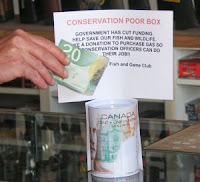 On June the 4th. Bill Otway, my wife and I visited the local sporting goods stores to set up donation boxes to collect money for the local Conservation Officers, so they at least can buy gas for their service vehicles. Of course we didn’t just go to the stores and set up “Poor Boxes” quietly. We invited the newspapers and the local television. They all attended the event and will report to the community about why we now have to help finance the Conservation Officers so they can continue to do their important work as the first line of defense against poaching and environmental pollution.
This “Poor Box” action initiated by the Nicola Valley Fish & Game Club has generated interest of other Fish and Game Clubs in British Columbia and soon it will catch on all over the province and generate a lot of public interest and that might be all that is needed to make the government rethink their short sighted budget cuts. Or as one store owner and former Conservation Officer put it eloquently. “With the recent budget cuts the government has cut the legs off of the guard dog.”
I leave you here with the official press release that we handed out.
Image courtesy of Bill Otway
Othmar Vohringer Outdoors
Founding Member of Outdoor Bloggers Summit
 As reported in an earlier article the government of British Columbia has again cut back the budget of the Fish and Wildlife Branch of the MOE (Ministry of Environment). This is a trend that unfortunately has become an annual ritual over the past several years while at the same time increasing the workload and duties of our Conservation Officers. The budget cutbacks are not about the lack of funding generated by hunters and fishers, which exceed the 400 million dollar mark, which would be more then enough money to finance the expenses of the Fish and Wildlife Branch. The cut backs are more about paying for an ever-expanding government bureaucracy and the multi-million boondoggle of the upcoming 2010 Winter Olympics.
Unfortunately, unlike America, British Columbia does not have a law like the Pittman-Robertson Act that would guarantee that hunter and angler generated money flows back to the Wildlife department. Instead the millions from hunting and fishing flow into the general province budget to be used in any which way the government sees fit.
Letters from outraged hunters, fishers and organizations to the government, complaining about the budget cuts to the Fish and Wildlife Branch that leaves our Conservation Officers basically without enough funding to operate - There isn't even enough money to fuel up the CO service vehicles - remained largely unanswered. In the rare occasions where replies were sent they consisted of the usual political excuses why cutbacks to the Fish and Wildlife Branch were necessary. Well, if the government does not listen to reason and commonsense they can maybe be shamed into listening. With that in mind a few members of the Nicola Valley Fish and Game Club, spearheaded by well known and respected Canadian outdoor personality Bill Otway, got together and initiated a “Poor Box” initiative.
 On June the 4th. Bill Otway, my wife and I visited the local sporting goods stores to set up donation boxes to collect money for the local Conservation Officers, so they at least can buy gas for their service vehicles. Of course we didn’t just go to the stores and set up “Poor Boxes” quietly. We invited the newspapers and the local television. They all attended the event and will report to the community about why we now have to help finance the Conservation Officers so they can continue to do their important work as the first line of defense against poaching and environmental pollution.
This “Poor Box” action initiated by the Nicola Valley Fish & Game Club has generated interest of other Fish and Game Clubs in British Columbia and soon it will catch on all over the province and generate a lot of public interest and that might be all that is needed to make the government rethink their short sighted budget cuts. Or as one store owner and former Conservation Officer put it eloquently. “With the recent budget cuts the government has cut the legs off of the guard dog.”
I leave you here with the official press release that we handed out.
Press Release –For immediate release
June 4, 2009
The members of the Nicola Valley Fish and Game Club are taking the action of setting up donation “Poor Boxes” in our local sporting goods stores today in recognition of the cutbacks our provincial government has made to the budget of the Fish and Wildlife Branch of the MOE.
Despite the fact that the licence fees paid by hunters, anglers and trappers in this province provide more than adequate funds to support fish and wildlife management and protection, funds for these purposes have been cut to the bone.
We find staff cut to below even minimum requirement levels. There is no money to carry out any real management programs including an almost total elimination of inventory of both fish and wildlife stocks.
We have been advised by the Acting Chief Conservation Officer that due to budget constraints Conservation Officers (C.O.s), are no longer allowed to have their government vehicles at home to allow quick response to emergency after hours calls. To add insult to injury we are also advised that C. O.s can only respond to after hour’s calls for incidents that are threats to human health or safety. So after hour’s pollution, poaching etc. will now go unchallenged. In short, the basic reason for the Conservation Officer Service being in existence is no longer on the charts.
The Conservation Officer is the first line of defence in the continuing efforts to maintain and enhance our fish and wildlife heritage. When you take away the first line of defence, you in fact erode the base and have begun the slide into oblivion for this heritage. This is why we have chosen to focus our efforts today on the plight of our Conservation Officer Service. Their plight is a clear indication of the current endemic problems that exist throughout the Fish and Wildlife Branch.
We have spoken with many of our sister clubs throughout the province and find that they are seeing the same problems with reduced enforcement and management as we are. They are supportive of our efforts and many are going to embark on a similar program in their own areas.
We, of course cannot provide funding to pay for the needed overtime and other costs of the Conservation Officers, but we felt that we and the community could contribute to the gas bill of the service. This we feel at the very least should free up some funds for government to be able to provide at least some after hours service. Moreover in many areas we are finding that in fact the current budget does not even provide for an adequate gasoline allowance to do adequate patrols in normal working hours.
We want to make it very clear that it is our experience that the staff in the Conservation Service are totally dedicated to their jobs and are committed to doing all they can to ensure we leave the best possible fish and wildlife heritage for future generations. We in the Nicola Valley Fishing and Game Club intend to do our part to aid these dedicated individuals to achieve their and our goals.
Bill Otway, Communications Chair
Nicola Valley Fish and Game Club
Image courtesy of Bill Otway
Othmar Vohringer Outdoors
Founding Member of Outdoor Bloggers Summit
Wednesday, April 29, 2009
Secret memo announces cutbacks for conservation services
© By Othmar Vohringer
If you live in British Columbia and contact the conservation services because you have bears in your back yard, or trying to break into your home, good luck to you if you get a response.
A secret memo leaked two week ago announces further financial cuts to the Wildlife Service. This is not the first time that budget cuts have been made but rather the last in a series over the last two to three years.
With the latest cutbacks there is serious concern that the Conservation Officers (Game Wardens for my American readers) will no longer be able to do their jobs. While the money has been steadily cut back over the years, the duties of the conservation officers have increased.
At one time the conservation officers were in charge of enforcing the hunting and fishing laws and responding to nuisance wildlife calls. That was a long time ago, now conservation officers are also in charge of enforcing environment pollution laws and a host of other duties pertaining to the environment, hunting, fishing and other outdoor recreational activates including vehicle/wildlife accidents.
Just how bad the current situation is has become evident when a memo was leaked to the public that among other things recommended. Conservation officers should not answer anymore phone calls from public made to the local office or the CO’s home, thus forcing the caller to call the central hotline from where the call will be assessed and forwarded to the conservation officer. Provided if the dispatcher deems the call urgent or not this could take from several hours to days.
Here is how this is intended to work. In the past if I encountered a wildlife act or environmental violation in progress I could just phone up the local conservation officer and inform him of my observation. The officer could make the decision based on his knowledge of the area and the people living there and if needed act upon my call within minutes.
With the new system I would have to phone the hotline in a faraway city where a bureaucrat will make the decision if the call is urgent or not and then, at his/her discretion, passes the message on to the local conservation officer. In the case of poaching or environment pollution minutes can make all the difference in apprehending an offender. The same is true if a bear creates havoc in my backyard or threatens my family. I want the problem to be dealt with in a timely, speak swift, fashion. I do not want to waist time talking to a bureaucrat somewhere far away that most likely has no clue of the area, or probably doesn’t even know it existed until now.
But it gets worse. In the leaked memo conservation officers are asked to hitch a ride with the RCMP when ever possible (That is police or sheriff for my American readers). Yep you read that right. The conservation service has no money to fuel up the patrol vehicles. In fact the conservation service is 500,000 dollars short of what is needed to maintain a basic service according to acting-chief conservation officer Lance Sundquist. British Columbia is a huge province. About three times the size of California, but only about 10% of California’s population, the rest is semi to total wilderness. Yet there are only 64 conservation officers in this province. That means that these officers have to drive hundreds of miles each day to patrol their territory and respond to calls, but with 500,000 dollars in the hole the vehicles stay in the parking lots with empty gas tanks.
Shan Simpson, NDP, said that with the latest cutbacks front-line officers would no longer be able to do their jobs. No kidding. Some of the conservation officers were so disgusted with this latest cutbacks that they left the service because they felt that they could not continue to uphold their oath any longer under the current conditions. The remaining officers struggle on as best as they can and a few, so I heard, even pay out of their own pocket to maintain some mobility. Imagine that! Pay so you can work!
All this comes on the back of BC Premier Gordon Campell’s, time and again, voiced commitment to environment, hunting and fishing. Looking at the facts this commitment seems nothing more than cheap lip service. As I said before this is not the first time the conservation service budget was cut back. In that same timeframe the government awarded itself, not once but twice, with a salary increase amounting to more that a 130% increase plus many other financial incentives and benefits. I am not even going into the millions that have been squandered or got “lost” in the 2010 Winter Olympics fiasco.
If we have to make cutbacks on the budget because of the economic situation, according to Gordon Campell, may I suggest to start on the over the top salaries and benefits of our government officials. I am sure with that alone a million or so could be saved. Clapping down on the 2010 Winter Olympics money squandering, fraud and corruption surely would save a few millions too. All that saved money could then be given to the conservation service, education department and health care department where the money is badly needed to keep up with the publics demand and needs.
If you live in British Columbia and contact the conservation services because you have bears in your back yard, or trying to break into your home, good luck to you if you get a response.
A secret memo leaked two week ago announces further financial cuts to the Wildlife Service. This is not the first time that budget cuts have been made but rather the last in a series over the last two to three years.
With the latest cutbacks there is serious concern that the Conservation Officers (Game Wardens for my American readers) will no longer be able to do their jobs. While the money has been steadily cut back over the years, the duties of the conservation officers have increased.
At one time the conservation officers were in charge of enforcing the hunting and fishing laws and responding to nuisance wildlife calls. That was a long time ago, now conservation officers are also in charge of enforcing environment pollution laws and a host of other duties pertaining to the environment, hunting, fishing and other outdoor recreational activates including vehicle/wildlife accidents.
Just how bad the current situation is has become evident when a memo was leaked to the public that among other things recommended. Conservation officers should not answer anymore phone calls from public made to the local office or the CO’s home, thus forcing the caller to call the central hotline from where the call will be assessed and forwarded to the conservation officer. Provided if the dispatcher deems the call urgent or not this could take from several hours to days.
Here is how this is intended to work. In the past if I encountered a wildlife act or environmental violation in progress I could just phone up the local conservation officer and inform him of my observation. The officer could make the decision based on his knowledge of the area and the people living there and if needed act upon my call within minutes.
With the new system I would have to phone the hotline in a faraway city where a bureaucrat will make the decision if the call is urgent or not and then, at his/her discretion, passes the message on to the local conservation officer. In the case of poaching or environment pollution minutes can make all the difference in apprehending an offender. The same is true if a bear creates havoc in my backyard or threatens my family. I want the problem to be dealt with in a timely, speak swift, fashion. I do not want to waist time talking to a bureaucrat somewhere far away that most likely has no clue of the area, or probably doesn’t even know it existed until now.
But it gets worse. In the leaked memo conservation officers are asked to hitch a ride with the RCMP when ever possible (That is police or sheriff for my American readers). Yep you read that right. The conservation service has no money to fuel up the patrol vehicles. In fact the conservation service is 500,000 dollars short of what is needed to maintain a basic service according to acting-chief conservation officer Lance Sundquist. British Columbia is a huge province. About three times the size of California, but only about 10% of California’s population, the rest is semi to total wilderness. Yet there are only 64 conservation officers in this province. That means that these officers have to drive hundreds of miles each day to patrol their territory and respond to calls, but with 500,000 dollars in the hole the vehicles stay in the parking lots with empty gas tanks.
Shan Simpson, NDP, said that with the latest cutbacks front-line officers would no longer be able to do their jobs. No kidding. Some of the conservation officers were so disgusted with this latest cutbacks that they left the service because they felt that they could not continue to uphold their oath any longer under the current conditions. The remaining officers struggle on as best as they can and a few, so I heard, even pay out of their own pocket to maintain some mobility. Imagine that! Pay so you can work!
All this comes on the back of BC Premier Gordon Campell’s, time and again, voiced commitment to environment, hunting and fishing. Looking at the facts this commitment seems nothing more than cheap lip service. As I said before this is not the first time the conservation service budget was cut back. In that same timeframe the government awarded itself, not once but twice, with a salary increase amounting to more that a 130% increase plus many other financial incentives and benefits. I am not even going into the millions that have been squandered or got “lost” in the 2010 Winter Olympics fiasco.
If we have to make cutbacks on the budget because of the economic situation, according to Gordon Campell, may I suggest to start on the over the top salaries and benefits of our government officials. I am sure with that alone a million or so could be saved. Clapping down on the 2010 Winter Olympics money squandering, fraud and corruption surely would save a few millions too. All that saved money could then be given to the conservation service, education department and health care department where the money is badly needed to keep up with the publics demand and needs.
Wednesday, March 18, 2009
Taking Action
© By Othmar Vohringer
Currently an anti hunting organization here in British Columbia called the Pacific Wild appears on TV channels all over the province in a effort to promote their bear hunting ban agenda.
As can be expected, the information contains a lot of junk science, heavily skewed and manipulated data and outright lies about bear hunting and conservation. In short anti hunting groups will say whatever they deem necessary to improve their financial bottom line and press the emotional buttons of the masses in the hope that they donate money to the organization.
As hunters we need to respond to such propaganda stunts that are solely aimed at maligning hunters for financial benefits. Here I leave you with the letter I wrote to the organization with carbon copies to the TV station that aired the diatribe and to our provincial government.
Currently an anti hunting organization here in British Columbia called the Pacific Wild appears on TV channels all over the province in a effort to promote their bear hunting ban agenda.
As can be expected, the information contains a lot of junk science, heavily skewed and manipulated data and outright lies about bear hunting and conservation. In short anti hunting groups will say whatever they deem necessary to improve their financial bottom line and press the emotional buttons of the masses in the hope that they donate money to the organization.
As hunters we need to respond to such propaganda stunts that are solely aimed at maligning hunters for financial benefits. Here I leave you with the letter I wrote to the organization with carbon copies to the TV station that aired the diatribe and to our provincial government.
To: PacificWild.org
info@pacificwild.org
Date: March 16, 2009
Re: Stop bear hunting in British Columbia
To Whom It May Concern:
Once again representatives of your organization have managed to go public with what best could be described as junk science and outright lies about the bear conservation, hunting and bear population numbers. Furthermore on your website you imply that hunters are lawbreakers by stating that bears are shot in Provincial and State Parks where hunting is not permitted.
As an interesting side note, your organization aligns itself with Coastal First Nations animal protection and conservation groups. This is very interesting because it is the First Nations that demanded special rights to hunt wherever, whenever and whatever they want without any regard to the regulations by which real hunters have to comply.
Through personal inside experience with animal rights and anti hunting groups I am fully aware that your organization is not overly concerned about real bear facts and conservation issues. Your main concern is the financial bottom line and to that end you will say whatever suits your political agenda and pushes the emotional buttons of a vastly ignorant people in the hope they will donate money to your extreme political cause.
Still I would like to provide you with the facts as they stand.
British Columbia has the most diverse and largest wildlife population in North America. BC is among the world leaders in wildlife and habitat conservation. The reason for our wildlife and habitat conservation success is a direct result of the close relationship between government and hunters. It was the hunters that first noticed a sharp decline in bear populations in the early 70's and demanded that the government stopped all bear hunting and not environmental groups. Environmental groups weren’t invented back then.
Since then, thanks to hunters working closely with wildlife biologists and the government of British Columbia, black bears and grizzly bears have bounced back to sustainable populations. Today the grizzly bear population is a conservatively estimated 14,000 strong and the black bear population is estimated at 160,000 strong (it's the largest grizzly and balck bear population anywhere in North America). These numbers are far from “an endangered species” as you erroneously but willfully claim.
To people with knowledge and real facts this does not come as a surprise because hunters are and always have been among the biggest wildlife conservationists. Long before it became a political agenda and money spin for extreme political groups.
Hunters only cull the surplus animals that need to be taken out of the population to ensure a healthy natural balance. Hunters cull less then 3% of the grizzly bear population. What animals and in what region the animals need to be culled is established by wildlife biologists that then in turn advice the government to allocate the necessary permits to hunters. Hunting is not as you imply random killing of animals, at least it is not for law-abiding hunters. Poachers are not hunters they are criminals.
Hunters contribute the lion share of finances needed for wildlife conservation through the purchase of hunting licenses. Hunters are also active in wildlife conservation organizations such as the hunter founded BC Wildlife Federation (BCWF), the Rocky Mountain Elk Foundation, Ducks Unlimited (DU), the Wild Sheep Society and the list goes on, providing further billions of dollars to benefit directly wildlife and habitat conservation. In other words, it is the hunters that put their money and personal effort where their mouth is to ensure a healthy and thriving wildlife population that can be equally enjoyed by all, including eco-tourists and those that want to outlaw hunting.
When was the last time your organization, or any other anti hunting organization for that matter, spent billions plus personal effort on wildlife conservation? The few known cases where wildlife conservation had been turned over to anti hunters ended in a complete conservation disaster causing diseases, starvation and habitat destruction.
Banning hunting would have a devastating effect on wildlife and environment. Who would pay the billions needed to keep wildlife conservation at the current high level? Who, if not hunters, would donate thousands of man hours dedicated to wildlife and habitat enhancement. Would your organization pay for it or should we leave it to the already overburdened taxpayers? Wildlife conservation certainly can’t be paid with eco-tourism (bear watching). On that note, have you ever bothered to read any data what eco-tourism does to wildlife and habitat? Look no further than Africa and the Yellow Stone National Park where wildlife has become habituated to people to the point where they become dangerous. Each year we learn of accidents where animals attack, injure and kill eco-tourists.Not to mention the damage caused to habitat and environment.
As an animal behaviorist I know how dangerous habituated wild animals can become to humans. Wildlife biologists in Africa view eco-tourism as a “huge problem” because once habituated animals tend to loose not only their natural respect of humans but also stop to behave and interact naturally with each other. In other words they behave like zoo animals, nature is turned into a drive through safari park.
In your publications you complain that the government doesn’t jump on your bandwagon. Here is the reason. Fortunately the government of British Columbia sees through the smoke screen you put up. Minister Penner knows the facts of hunting and wildlife conservation and that is why he turns your proposal down and for that alone he will get my vote in the upcoming election.
Sincerely
Othmar Vohringer
CC to Honorable Barry Penner, B.C. Minister of Environment
CC to Honorable Gordon Campbell, Premier of British Columbia
CC to CBC TV
CC to Global TV
Tuesday, August 26, 2008
Baby Moose Rescued by Hunter
© By Othmar Vohringer
Patrick sent me an email about a baby moose that has been rescued by a hunter.
The man found the distressed moose calf in a creek. He helped the poor creature out and then proceeded to find its mama. The hunter took the calf to a place where he suspected the mother to be and left. Eventually the baby moose stumbled right back into the creek and had to be rescued again. After this second rescue the calf wouldn’t leave the side of the hunter and consequently followed him home.
Living only in a small cabin he had no room to accommodate a four-legged guest that obviously would grow much larger in a relatively short time. The next day the hunter took the orphaned moose calf to a woman who has specialized in looking after abandoned wildlife. The calf is doing fine sharing a large pen with a rescued mule deer fawn.
Unfortunately I could not find out where this happened or the name of the hunter who rescued the moose. It is moments like this that make me proud to be a hunter and belonging to a community that cares about wildlife. This is a far cry from the bloodthirsty uncaring behavior with which hunters are often portrayed in public. To that end I leave you here with a few photos to enjoy.


Tags: Moose Rescue, Wildlife Conservation, Hunter Helps Baby Moose, News
Patrick sent me an email about a baby moose that has been rescued by a hunter.
The man found the distressed moose calf in a creek. He helped the poor creature out and then proceeded to find its mama. The hunter took the calf to a place where he suspected the mother to be and left. Eventually the baby moose stumbled right back into the creek and had to be rescued again. After this second rescue the calf wouldn’t leave the side of the hunter and consequently followed him home.
Living only in a small cabin he had no room to accommodate a four-legged guest that obviously would grow much larger in a relatively short time. The next day the hunter took the orphaned moose calf to a woman who has specialized in looking after abandoned wildlife. The calf is doing fine sharing a large pen with a rescued mule deer fawn.
Unfortunately I could not find out where this happened or the name of the hunter who rescued the moose. It is moments like this that make me proud to be a hunter and belonging to a community that cares about wildlife. This is a far cry from the bloodthirsty uncaring behavior with which hunters are often portrayed in public. To that end I leave you here with a few photos to enjoy.


Tags: Moose Rescue, Wildlife Conservation, Hunter Helps Baby Moose, News
Wednesday, March 07, 2007
Wolves attack moose
Today a friend sent me this picture sequence, showing a pride of wolves attacking a moose. The attached note said; “Wolf tag or no wolf tag, this wouldn’t have happened if I would have been in that tree stand.”
Somehow I am not surprised to read that comment. Many hunters get upset when they see pictures of wolves taking care of their dietary needs. I often wondered why that is so. I came to the conclusion that the only reason hunters do not like wolves must be because they are hunters too. Or in other words, some of us might view the wolf as direct hunting competitor. This thinking is in line with what some hunters told me, saying something like; “The wolf steals our game.”
Of course it is utter nonsense that the wolf “steals our game”. The animals we hunt are not our game. We share the game animals with other hunters, like the wolf, the coyote, grizzly bear and other predators that have as much right to hunt for food as we do. Together we are all part of natures check and balance system that has worked so well for millions of years and hopefully will continue to work well for all of us, humans and animals alike.
The wolves found a cow moose (probably an old weak animal). The two wolves chase the moose to tire her out.
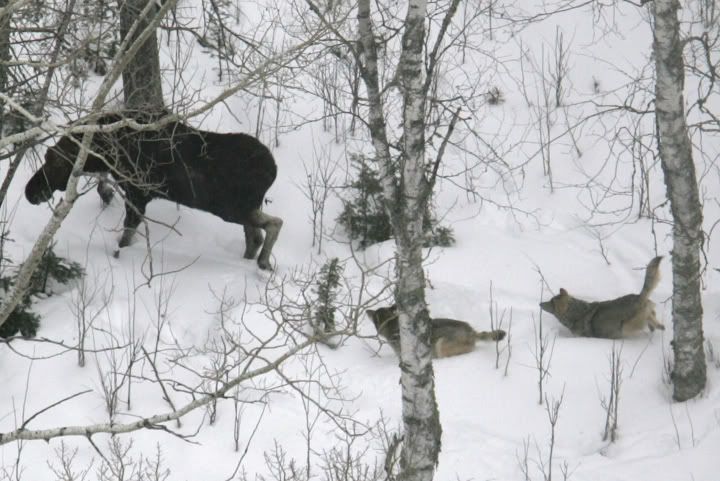
The two wolves are soon to be joined my other pride members that circle the moose and make an escape impossible. The fate of the moose is sealed, would that moose be a fully grown bull he would have a good chance to break loose from the deadly circle.
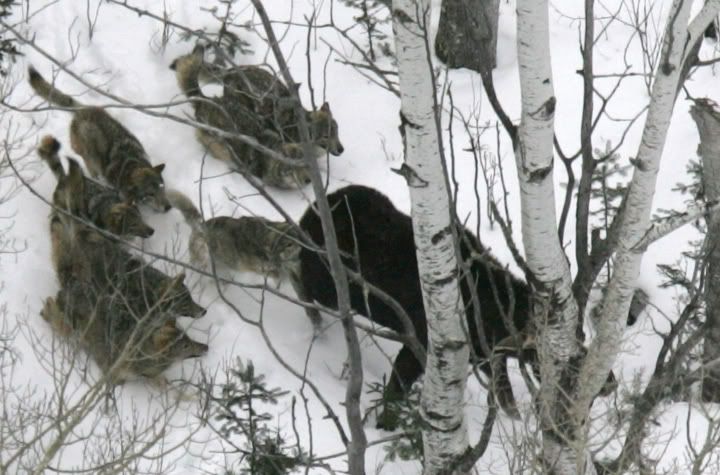
The older and experienced wolves are the ones that do the killing by holding the prey animal mouth and nose closed (suffocating) while other wolves bite the animal in the neck. For us humans this is a gruesome death. However, research has clearly shown that animals have a much higher pain tolerance than humans, plus the prey animal is in shock at this stage and feels no or very little pain.
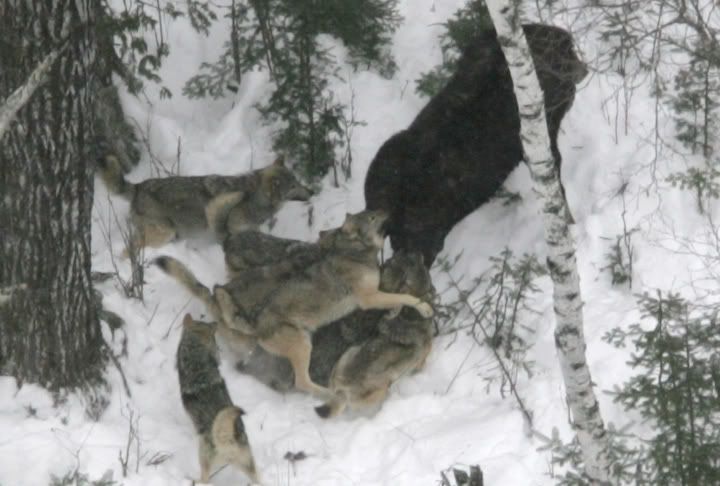
The table is set and the non-hunting members of the wolf pride join in the feast.
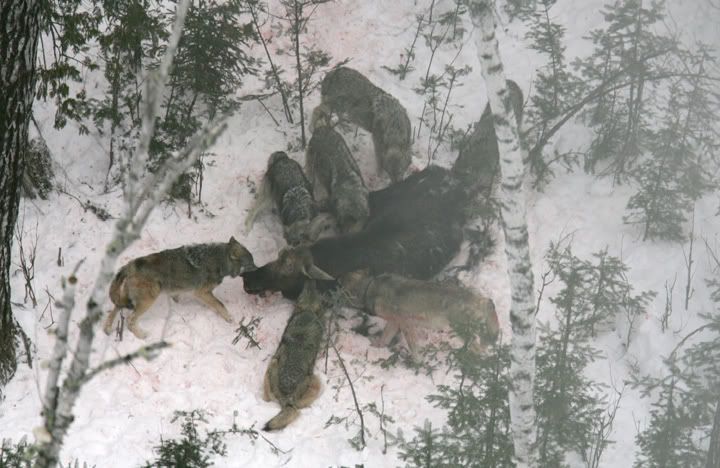
Tags: Wolf, Wolf Pride, Wolf+Attack, Moose, Wildlife
Somehow I am not surprised to read that comment. Many hunters get upset when they see pictures of wolves taking care of their dietary needs. I often wondered why that is so. I came to the conclusion that the only reason hunters do not like wolves must be because they are hunters too. Or in other words, some of us might view the wolf as direct hunting competitor. This thinking is in line with what some hunters told me, saying something like; “The wolf steals our game.”
Of course it is utter nonsense that the wolf “steals our game”. The animals we hunt are not our game. We share the game animals with other hunters, like the wolf, the coyote, grizzly bear and other predators that have as much right to hunt for food as we do. Together we are all part of natures check and balance system that has worked so well for millions of years and hopefully will continue to work well for all of us, humans and animals alike.
The wolves found a cow moose (probably an old weak animal). The two wolves chase the moose to tire her out.

The two wolves are soon to be joined my other pride members that circle the moose and make an escape impossible. The fate of the moose is sealed, would that moose be a fully grown bull he would have a good chance to break loose from the deadly circle.

The older and experienced wolves are the ones that do the killing by holding the prey animal mouth and nose closed (suffocating) while other wolves bite the animal in the neck. For us humans this is a gruesome death. However, research has clearly shown that animals have a much higher pain tolerance than humans, plus the prey animal is in shock at this stage and feels no or very little pain.

The table is set and the non-hunting members of the wolf pride join in the feast.

Tags: Wolf, Wolf Pride, Wolf+Attack, Moose, Wildlife
Subscribe to:
Posts (Atom)
